

AI Trading Agent With Memory and Tool Use in Python
Build an AI trading agent with memory and tool use in Python — LLM reasoning, short/long-term memory, RAG, vector databases, tool orchestration, multi-agent architecture, and production risk controls for autonomous trading.
AI Trading Agent With Memory and Tool Use in Python: Building Autonomous Quantitative Trading Systems
Imagine waking up in the morning and finding that your trading system has already analyzed overnight market activity, identified unusual volatility, retrieved fresh macroeconomic data, compared current conditions to similar historical periods, adjusted its market outlook, evaluated existing positions, generated new trade candidates, and logged every decision for future learning — all without being explicitly programmed for every possible scenario.
This is the promise of AI agents. While algorithmic trading systems have existed for decades, most traditional trading bots follow rigid workflows: receive market data, calculate indicators, generate signals, execute trades. These systems can be effective, but they are limited by predefined logic.
AI trading agents introduce something fundamentally different: reasoning. Instead of merely following instructions, agents can analyze situations, choose actions, use tools, retrieve information, maintain memory, and adapt their behavior based on changing circumstances.
In this guide, you'll learn what an AI trading agent is, why memory matters, tool use architectures, agent workflows, long-term and short-term memory, Retrieval-Augmented Generation (RAG), Python implementation examples, risk management considerations, multi-agent trading systems, and common mistakes and best practices.
What Is an AI Trading Agent?
What makes an agent different from a traditional trading bot? A traditional bot follows predefined logic: if rsi < 30: buy(). The bot cannot explain its reasoning, investigate unusual events, or adapt to new information.
An AI agent operates differently. The agent receives an objective — for example, "Identify promising swing trading opportunities while maintaining portfolio risk below 2%." The agent then determines what information is needed, which tools to use, how to analyze the data, and what actions should be taken. This creates a more flexible decision-making framework.
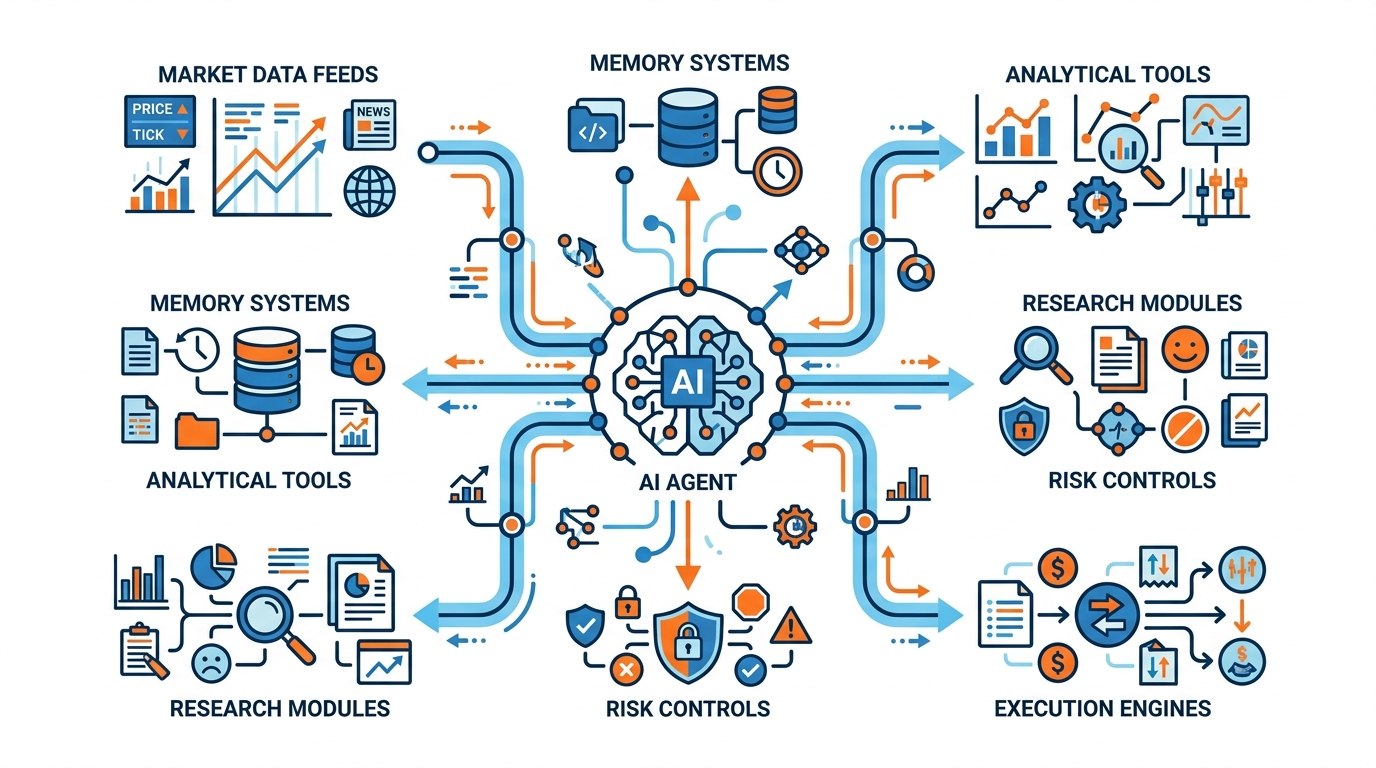
The Core Components of an AI Trading Agent
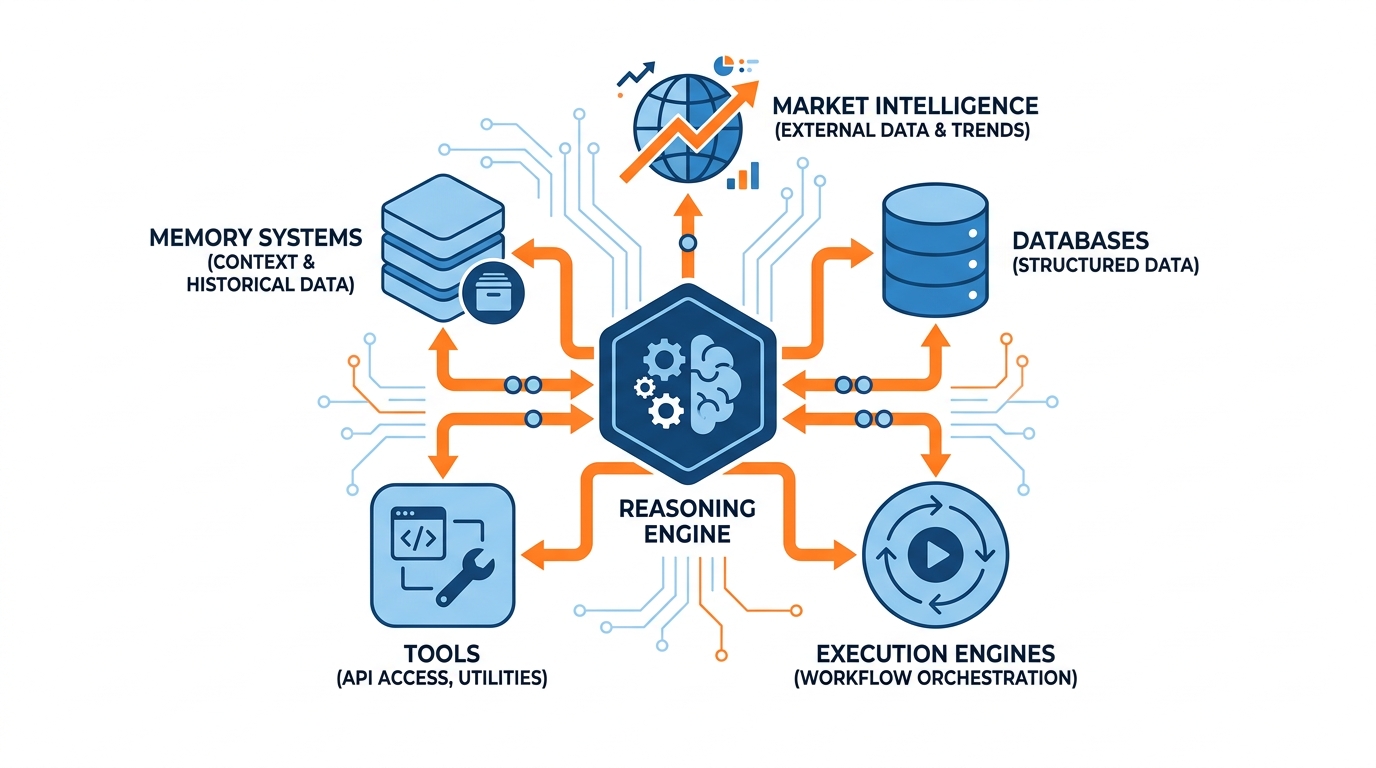
The Reasoning Engine: Typically powered by an LLM, responsible for analysis, planning, decision-making, tool selection, and trade explanations. Rather than directly executing trades, it acts as the agent's brain.
Memory: Enables learning and context retention. Without memory, every interaction becomes isolated — the agent repeatedly forgets previous observations. With memory, it can recall past trades, track market regimes, remember historical events, and reference prior analyses.
Tools: Extend the agent's capabilities — market data retrieval, database access, technical analysis, risk calculations, news retrieval, portfolio inspection, and order execution. Tools allow the agent to interact with the external world.
Execution Layer: Performs actions — submit orders, modify positions, update logs, store research. Transforms decisions into outcomes.
Why Memory Matters in Trading Agents
Imagine a human trader with no memory. Every morning they forget previous trades, market conditions, portfolio history, and risk events. Their effectiveness would be severely limited. The same applies to AI agents.
Short-Term Memory: Stores recent context — current positions, recent market observations, active analyses, ongoing tasks. Frequently updated.
Long-Term Memory: Stores durable knowledge — historical trade outcomes, market regime observations, strategy performance, research notes. Persists over extended periods.
Episodic Memory: Records specific experiences — major market crashes, unexpected losses, exceptional trades. Influences future decisions.
Semantic Memory: Stores facts — economic relationships, market definitions, trading rules. Forms the agent's knowledge base.
Building Agent Memory in Python
1memory = []
2memory.append({"date": "2025-01-10", "event": "BTC breakout", "volatility": 0.045})
In production systems, memory often resides in PostgreSQL, SQLite, vector databases, or document stores — supporting persistent storage and retrieval.
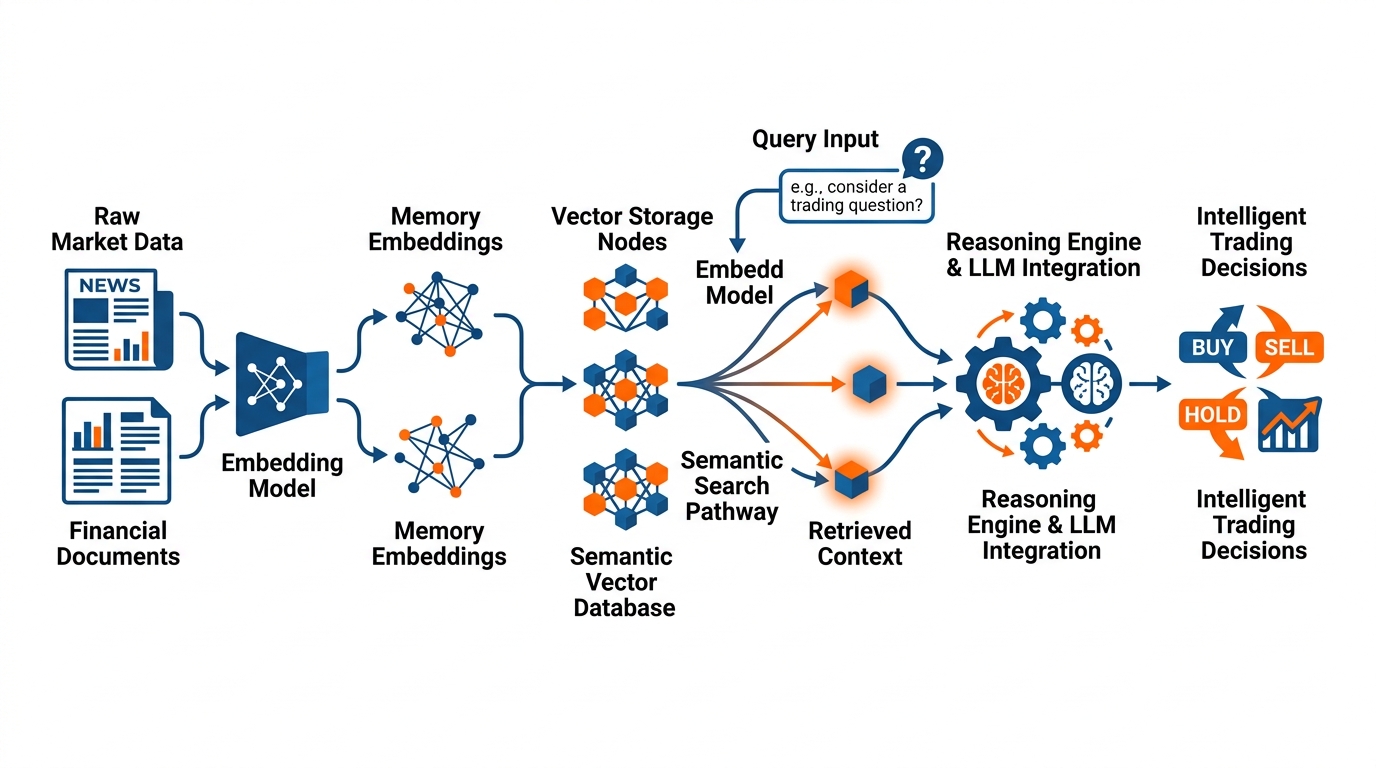
Vector Memory and Retrieval-Augmented Generation (RAG)
As memory grows, searching becomes challenging. Vector databases solve this — information is converted into embeddings where similar observations become mathematically close. When the agent encounters a new situation, it retrieves relevant memories through RAG. Benefits include better contextual reasoning, historical awareness, reduced hallucination, and more consistent decisions.
Tool Use: The Superpower of AI Agents
An LLM alone can only reason with information already provided. It cannot access live prices, query databases, or execute trades. Tools solve this limitation — a tool is simply a function the agent can call.
1def calculate_rsi(data):
2    # RSI logic
3    return rsi_value
4
5tools = {"calculate_rsi": calculate_rsi}
Essential Tools for Trading Agents
Market Data Tools: OHLCV retrieval, tick data, order book data, funding rates.
Analytics Tools: Technical indicators, volatility estimation, correlation analysis, factor calculations.
Research Tools: News retrieval, earnings data, economic releases.
Portfolio Tools: Position inspection, exposure calculation, PnL reporting.
Execution Tools: Buy orders, sell orders, position modifications.
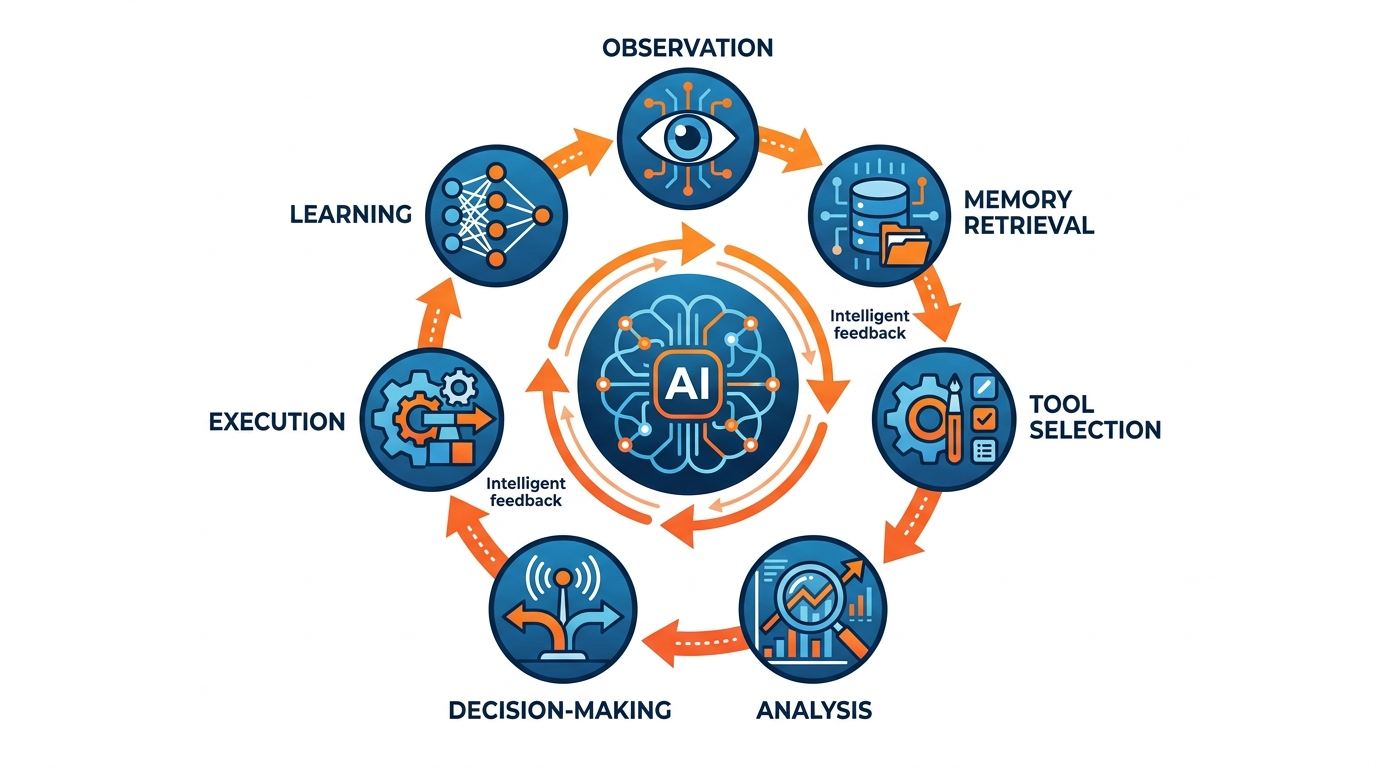
Agent Decision Workflow
Step 1: Observe market conditions. Step 2: Retrieve relevant memories. Step 3: Identify information gaps. Step 4: Select tools. Step 5: Analyze results. Step 6: Generate recommendations. Step 7: Execute actions if permitted. Step 8: Store outcomes in memory. This loop allows continuous adaptation.
Multi-Agent Trading Systems
Many advanced architectures employ multiple specialized agents:
- Research Agent: Market analysis, news interpretation, opportunity identification
- Risk Agent: Position limits, VaR calculations, drawdown monitoring
- Execution Agent: Order routing, slippage management, trade execution
- Portfolio Agent: Capital allocation, rebalancing, exposure management
This specialization often improves reliability.
Memory-Driven Market Regime Detection
Suppose the agent encounters rising volatility, falling liquidity, and increasing correlations. The agent retrieves historical periods with similar characteristics and discovers that previous occurrences frequently led to market corrections. This information influences decision-making — the agent effectively learns from experience.
Risk Management for AI Trading Agents
Professional systems implement strict safeguards: position limits (maximum allocation % of portfolio value), portfolio risk limits (maximum VaR), daily loss limits (maximum daily loss), and human approval for high-risk actions requiring manual confirmation. These controls reduce catastrophic failure risk.
Common Mistakes When Building AI Trading Agents
- Giving Agents Direct Trading Authority: Agent recommendations should pass through multiple validation layers before execution. Treat the agent as an intelligent advisor, not an unrestricted trader.
- Neglecting Memory Architecture: Agents operating only on current context constantly forget valuable information. Combine short-term working memory with long-term storage.
- Providing Too Many Tools: As tools grow, the decision space becomes increasingly complex. Curate toolsets for specific tasks.
- Failing to Maintain an Audit Trail: Capture prompts, retrieved information, tool invocations, reasoning outputs, recommendations, risk checks, and execution decisions.
- Ignoring Latency and Computational Costs: Agents add computation between data and decisions. Evaluate compatibility with strategy speed requirements.
- Trusting Every Agent Output: Incorporate independent verification layers — quantitative models, rule-based validation, consistency checks, and risk controls.
- Ignoring Human-in-the-Loop Design: The most effective systems preserve human oversight for high-impact decisions while automating research and analysis.
- Underestimating Monitoring and Observability: Monitor tool usage frequency, reasoning duration, retrieval quality, recommendation accuracy, execution outcomes, error rates, and decision consistency.
A Practical End-to-End Architecture
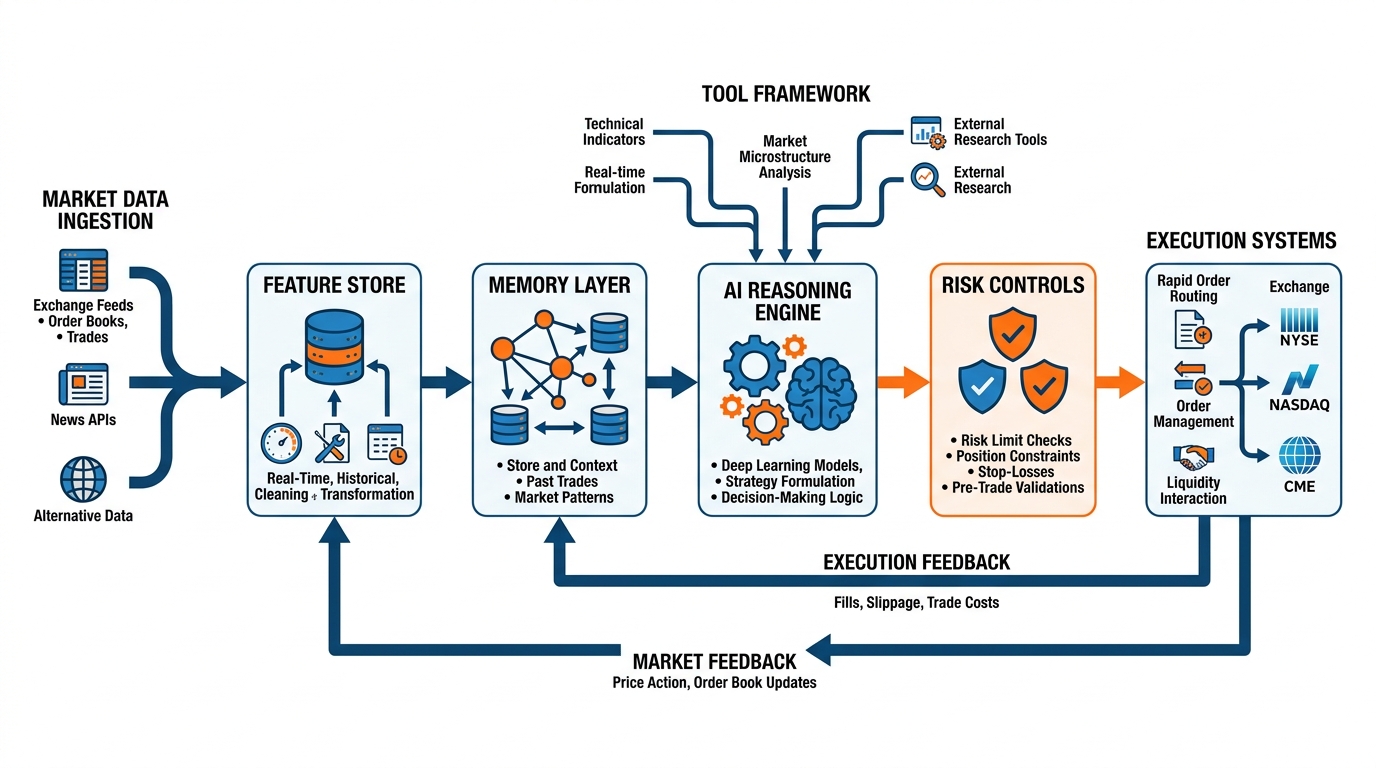
Market Data Sources → Feature Store → Memory Layer → LLM Agent → Tool Layer → Risk Engine → Execution Engine → Broker/Exchange → Trade Logs → Memory Updates. This creates a closed learning loop — the agent continuously observes, reasons, acts, and learns.
Future Directions
The next generation of AI trading agents will likely incorporate long-horizon planning, self-improving research workflows, advanced memory systems, multi-agent collaboration, autonomous strategy generation, cross-market reasoning, and real-time portfolio optimization. The boundary between quantitative research systems and autonomous agents is becoming increasingly blurred.
Key Takeaways
- AI trading agents differ from traditional bots because they can reason, plan, and use tools
- Memory enables historical awareness and contextual decision-making
- Short-term and long-term memory serve different purposes
- Vector databases and RAG improve memory retrieval
- Tool use allows agents to interact with market data, analytics, and execution systems
- Multi-agent architectures often improve scalability and reliability
- Risk management remains essential regardless of AI capabilities
- Logging and auditability are critical for production systems
- The most powerful agents combine memory, tools, reasoning, and structured safeguards
Conclusion
Traditional algorithmic trading systems excel at executing predefined rules. AI trading agents represent a shift toward adaptive systems capable of reasoning about complex situations, retrieving historical context, selecting appropriate tools, and continuously updating their understanding of the market.
The combination of memory and tool use is what transforms a language model into an agent. Memory provides experience. Tools provide capabilities. Together they create systems that can operate with far greater flexibility than conventional trading bots.
However, successful trading agents are not built solely around intelligence. They require careful architecture, robust memory management, reliable tool integrations, strict risk controls, and comprehensive audit trails. Without these components, even the most sophisticated reasoning engine can become a liability.
As AI infrastructure continues to evolve, trading agents will likely become increasingly common within quantitative research and portfolio management workflows. Traders who understand how memory, tool use, and autonomous decision-making fit together will be well-positioned to build the next generation of intelligent trading systems. The future of algorithmic trading may not be a bot that simply follows rules. It may be an agent that learns, remembers, reasons, and continuously adapts alongside the markets it trades.