

AI Signal Fusion Systems for Advanced Trading Strategies
Learn how AI signal fusion systems combine multiple independent indicators, machine learning, and regime detection into adaptive trading architectures. Build smarter probabilistic strategies with Python and ensemble methods.
AI Signal Fusion Systems for Advanced Trading Strategies: Building Smarter Algo Trading Models
Algorithmic traders often believe the secret to profitability lies in finding the one perfect indicator. A magical oscillator. A hidden candlestick pattern. A predictive neural network.
But the traders who survive real markets eventually discover something uncomfortable: a single signal almost always fails.
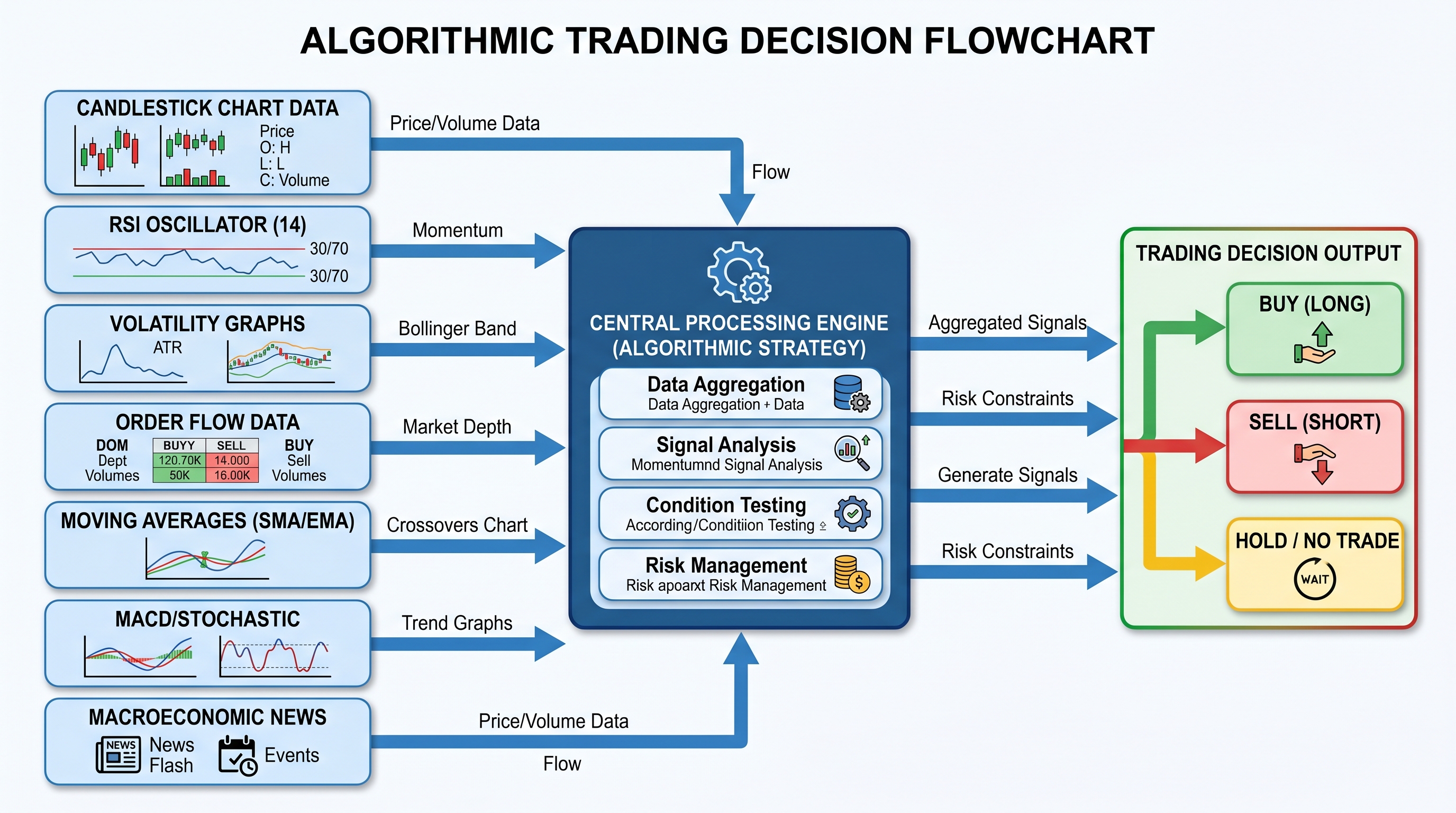
Markets change regimes. Trends disappear. Volatility explodes. Correlations break. What worked beautifully last month suddenly becomes a drawdown machine. This is why sophisticated trading firms rarely rely on isolated indicators. Instead, they build signal fusion systems — frameworks that combine multiple independent signals into a unified decision-making engine.
Instead of asking "Is RSI overbought?", advanced traders ask: What does momentum say? What does volatility imply? Is market structure supportive? Are order flows aligned? What is the macro regime? What probability does the model assign to continuation?
Why Single Indicators Fail in Real Markets
Imagine using a simple moving average crossover strategy. It performs well during trending markets. Then the market enters consolidation — false breakouts increase, signals conflict, drawdowns compound, and transaction costs rise.
The issue isn't the moving average itself. The issue is that markets are multidimensional. Price alone does not capture volatility state, liquidity conditions, momentum exhaustion, institutional participation, cross-asset relationships, or market regime transitions. A single indicator observes only one small slice of reality. AI signal fusion systems observe many slices simultaneously.
What Is an AI Signal Fusion System?
An AI signal fusion system combines multiple independent trading signals into a single predictive framework. Instead of generating trades from one indicator, the system integrates technical indicators, statistical signals, market microstructure data, alternative data, machine learning predictions, and regime detection models.
The final output becomes a probabilistic decision:
Where s₁,...,sn are individual signals, w₁,...,wn are dynamic weights, and Sfused is the aggregated trading score. Different signals work better under different market conditions — a volatility breakout signal may dominate during high volatility, while a mean-reversion signal may dominate during range-bound markets. AI helps dynamically determine which signals deserve more trust.
The Five Core Layers of Signal Fusion Architecture
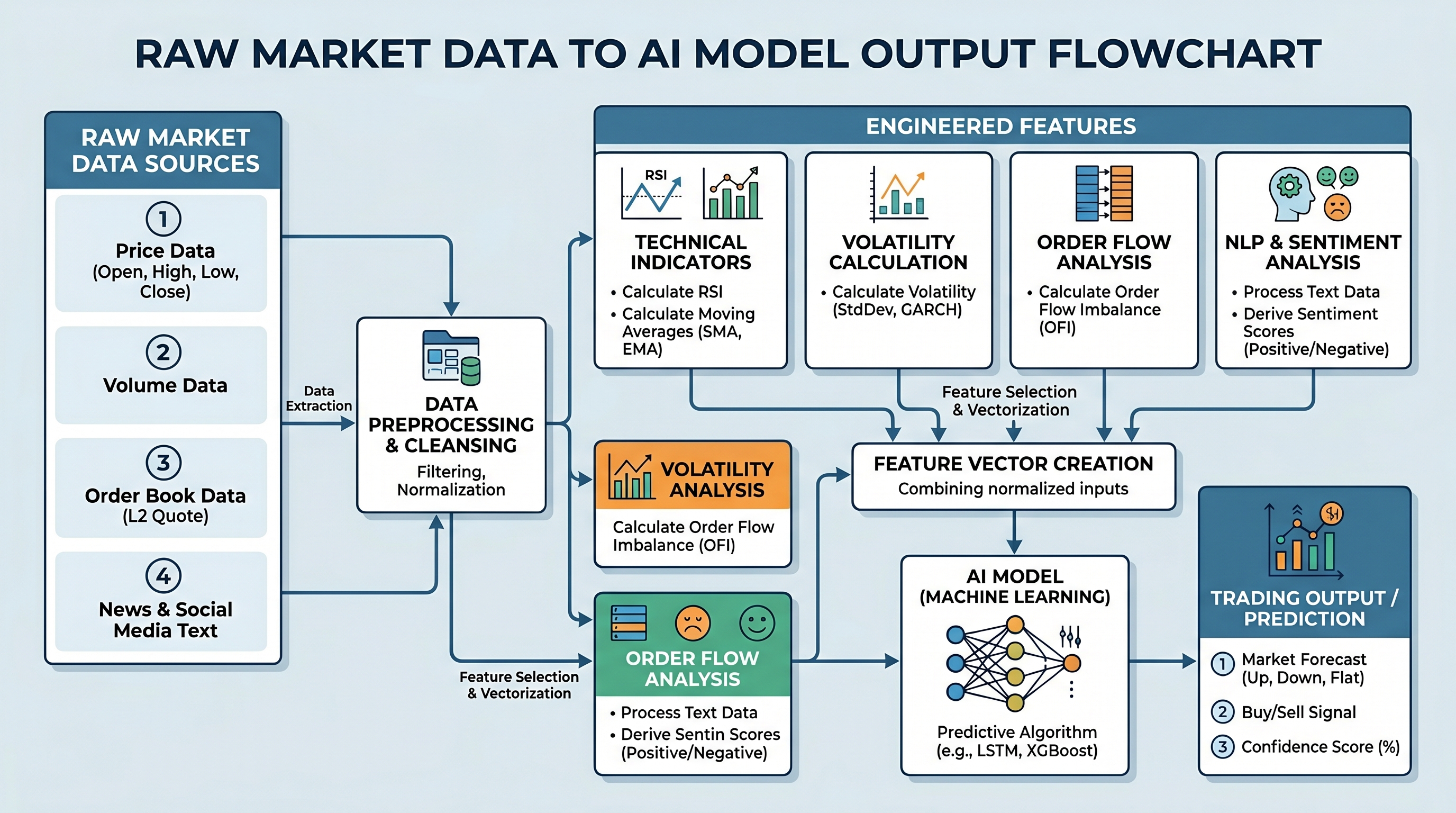
1. Data Layer
Everything starts with data — OHLCV price data, order book data, news sentiment, economic indicators, options flow, funding rates (crypto), on-chain metrics, and correlation matrices. The richer your data diversity, the richer your signal space.
2. Feature Engineering Layer
Raw data is rarely useful directly. Feature engineering transforms it into meaningful signals: momentum features (rate of change, RSI), volatility features (rolling standard deviation, ATR), trend features (ADX, moving average slopes), and market regime features (Hurst exponent, volatility regimes).
3. Signal Generation Layer
Individual signals are computed, tested, and validated independently before fusion.
4. Fusion / Aggregation Layer
Signals are combined using rule-based logic, weighted scoring, or AI/ML models.
5. Decision / Execution Layer
The fused output generates position sizing, risk constraints, and execution instructions.
Understanding Signal Correlation
One of the biggest beginner mistakes is combining indicators that say the exact same thing. MACD, RSI, and Stochastic oscillator are all momentum-oriented — adding them together creates redundancy rather than diversification.
Professional signal fusion systems seek orthogonal signals — signals that capture different dimensions:
| Dimension | Signal Type | Example |
|---|---|---|
| Trend | Directional | Moving average alignment |
| Momentum | Speed/Strength | RSI, Rate of Change |
| Volatility | Uncertainty | ATR, Bollinger Band width |
| Volume | Participation | OBV, volume relative to average |
| Structure | Price action | Support/resistance, patterns |
| Sentiment | Market psychology | News NLP, Fear & Greed Index |
The less correlated your signals, the more powerful the fusion becomes. Low correlation between signals improves robustness:
Rule-Based vs AI-Driven Fusion Systems
Rule-based fusion uses static logic — e.g., "Buy if RSI < 30 AND price above 200 EMA AND volume above average." Simple and interpretable, but rigid.
AI-driven systems are different: machine learning models learn relationships automatically from data.
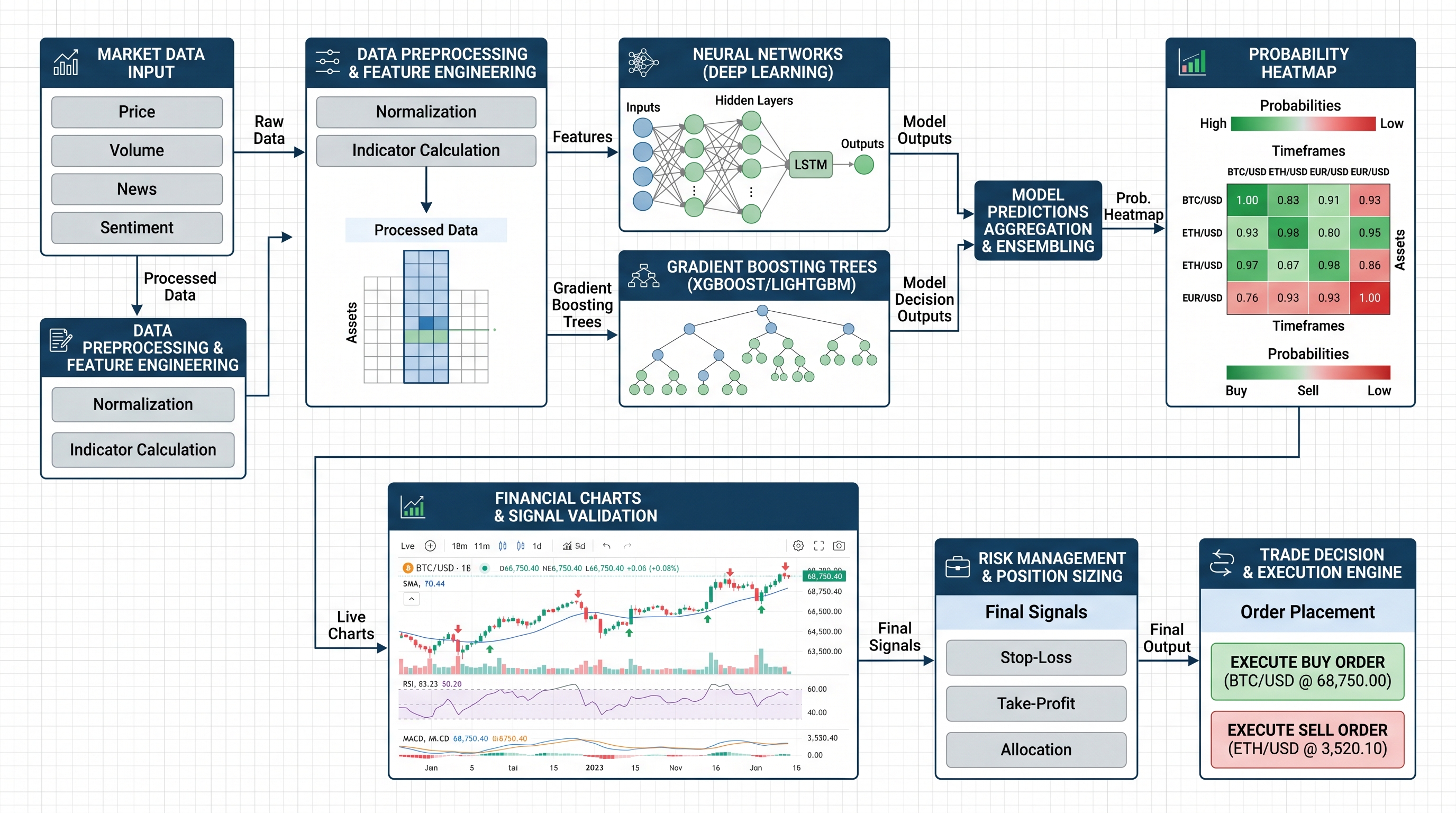
Machine Learning Models for Signal Fusion
- Random Forests — Excellent for structured financial features, handles nonlinear relationships, resistant to overfitting, interpretable feature importance
- Gradient Boosting (XGBoost, LightGBM, CatBoost) — Dominates quantitative competitions, handles noisy tabular data extremely well
- Neural Networks (LSTMs, Transformers, Temporal CNNs) — Useful for pattern recognition, high-dimensional feature spaces, and sequence modeling
- Reinforcement Learning — Optimizes actions directly (when to enter, exit, how much to risk) based on reward maximization, though substantially harder to stabilize in real markets
Building an AI Signal Fusion Model in Python
Step 1: Generate Diverse Features
1import pandas as pd
2import numpy as np
3
4df = pd.read_csv("btc_data.csv")
5df["returns"] = df["Close"].pct_change()
6df["sma_fast"] = df["Close"].rolling(10).mean()
7df["sma_slow"] = df["Close"].rolling(50).mean()
8df["momentum"] = df["Close"] / df["Close"].shift(10) - 1
9df["volatility"] = df["returns"].rolling(20).std()
10df = df.dropna()
This creates trend, momentum, and volatility features — diverse information for the model.
Step 2: Create Prediction Labels
1df["future_return"] = df["Close"].shift(-5) / df["Close"] - 1
2df["target"] = (df["future_return"] > 0).astype(int)
Step 3: Train a Machine Learning Model
1from sklearn.ensemble import RandomForestClassifier
2from sklearn.model_selection import train_test_split
3
4features = ["momentum", "volatility"]
5X = df[features]
6y = df["target"]
7
8X_train, X_test, y_train, y_test = train_test_split(
9    X, y, shuffle=False
10)
11
12model = RandomForestClassifier(n_estimators=200, max_depth=5)
13model.fit(X_train, y_train)
Step 4: Generate Probabilistic Signals
1df["probability"] = model.predict_proba(X)[:, 1]
2df["signal"] = np.where(df["probability"] > 0.6, 1, 0)
Instead of binary indicators, we now obtain probabilities. Professional trading systems think in probabilities rather than certainty — a major conceptual shift.
Dynamic Weighting: The Real Power of Signal Fusion
Static weights are limited. AI systems become far more powerful when signal importance adapts dynamically. Trend following works well during bull markets; mean reversion works during sideways markets. Dynamic weighting adjusts automatically:
Signals performing better recently receive higher allocation — creating adaptive intelligence.
Regime Detection: The Missing Layer
Many trading systems fail because they assume markets behave consistently. They do not. Markets transition through trending, mean-reverting, high volatility, low volatility, risk-on, and risk-off regimes.
Signal fusion systems become dramatically more robust when regime awareness is added. The system can activate or deactivate specific signals depending on detected conditions — trend-following signals during trending regimes, mean-reversion during ranging, reduced exposure during crisis volatility.
Ensemble Learning in Trading Systems
One ML model may not generalize well. Advanced systems use ensembles combining Random Forest, XGBoost, and Neural Networks:
Ensembles improve stability, generalization, and noise resistance — mirroring hedge fund architecture where rarely a single model controls everything.
Feature Importance: Discovering What Actually Matters
1importance = pd.DataFrame({
2    "feature": features,
3    "importance": model.feature_importances_
4})
5print(importance.sort_values(by="importance", ascending=False))
You may discover that volatility matters more than momentum, volume spikes predict reversals, or trend strength dominates during macro events. This transforms trading into a research-driven process.
Risk Management Inside AI Fusion Systems
Many beginners focus entirely on entries. Professionals focus on survival. AI signal fusion systems should integrate risk directly:
Position sizing:
Higher volatility reduces exposure automatically, stabilizing portfolio variance.
Confidence-based execution: 51% model confidence → small trade; 85% confidence → larger trade. This probabilistic framework creates smoother equity curves.
Avoiding Overfitting in Signal Fusion Models
A model may appear brilliant historically while failing completely live — because it memorized noise. Common causes: too many features, data leakage, excessive optimization, small datasets, ignoring transaction costs.
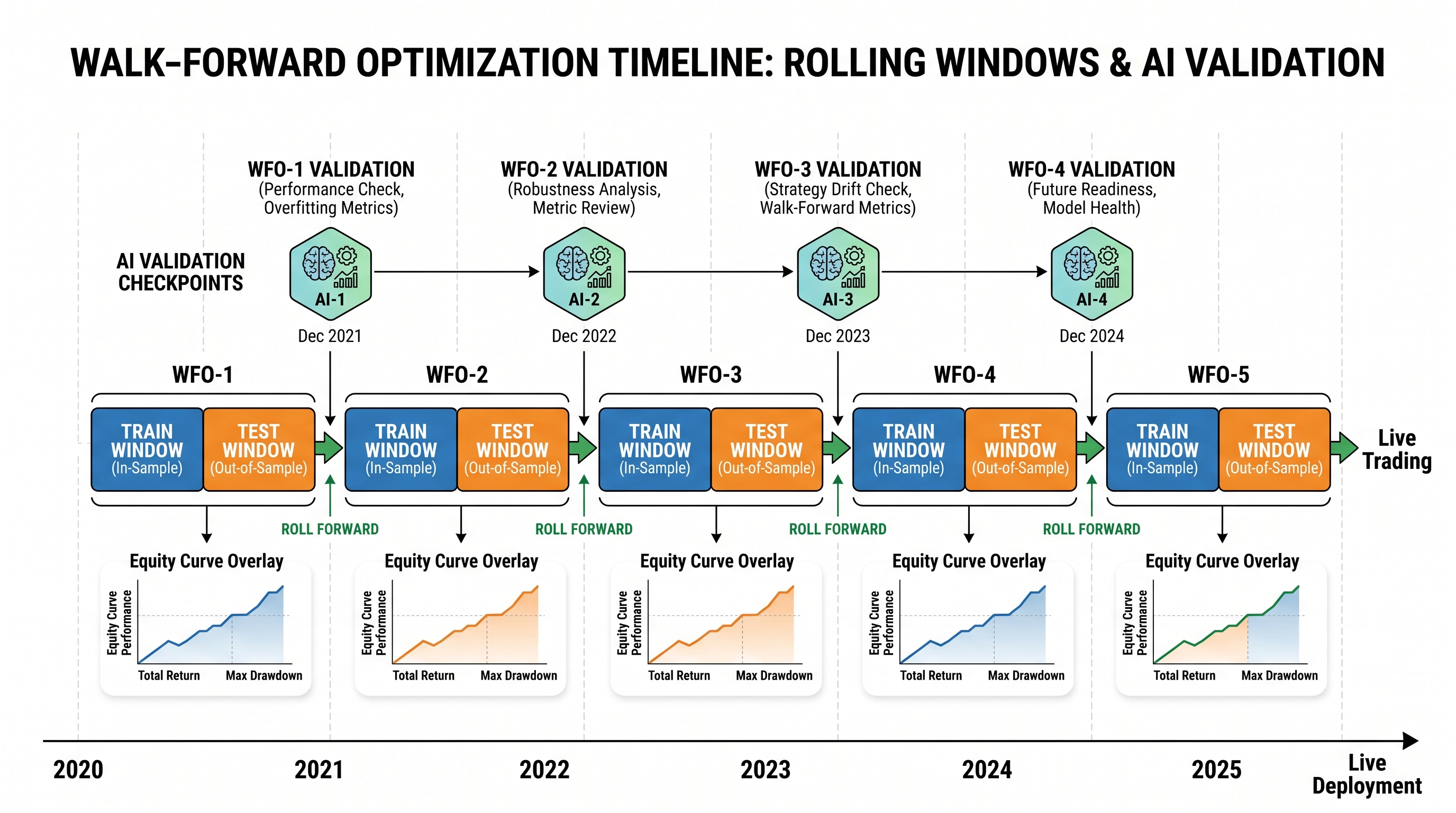
Walk-Forward Validation
Professional systems use walk-forward testing rather than one-shot train/test:
1for train_end in training_dates:
2    train = data[:train_end]
3    test = data[train_end:train_end + window]
4    model.fit(train)
5    predictions = model.predict(test)
This better simulates live deployment where models must perform on truly unseen data.
Latency and Real-Time Considerations
Backtests are easy. Real-time execution is harder. AI fusion systems must consider API latency, slippage, data synchronization, execution delays, and exchange outages. A profitable model can fail operationally — infrastructure matters.
Advanced Signal Fusion Techniques
- Bayesian Signal Fusion — Continuously updates probabilities using Bayes' theorem:
- Attention Mechanisms — Transformer architectures learn which signals deserve attention dynamically
- Meta Models — A model that predicts whether another strategy should be trusted right now, creating layered intelligence
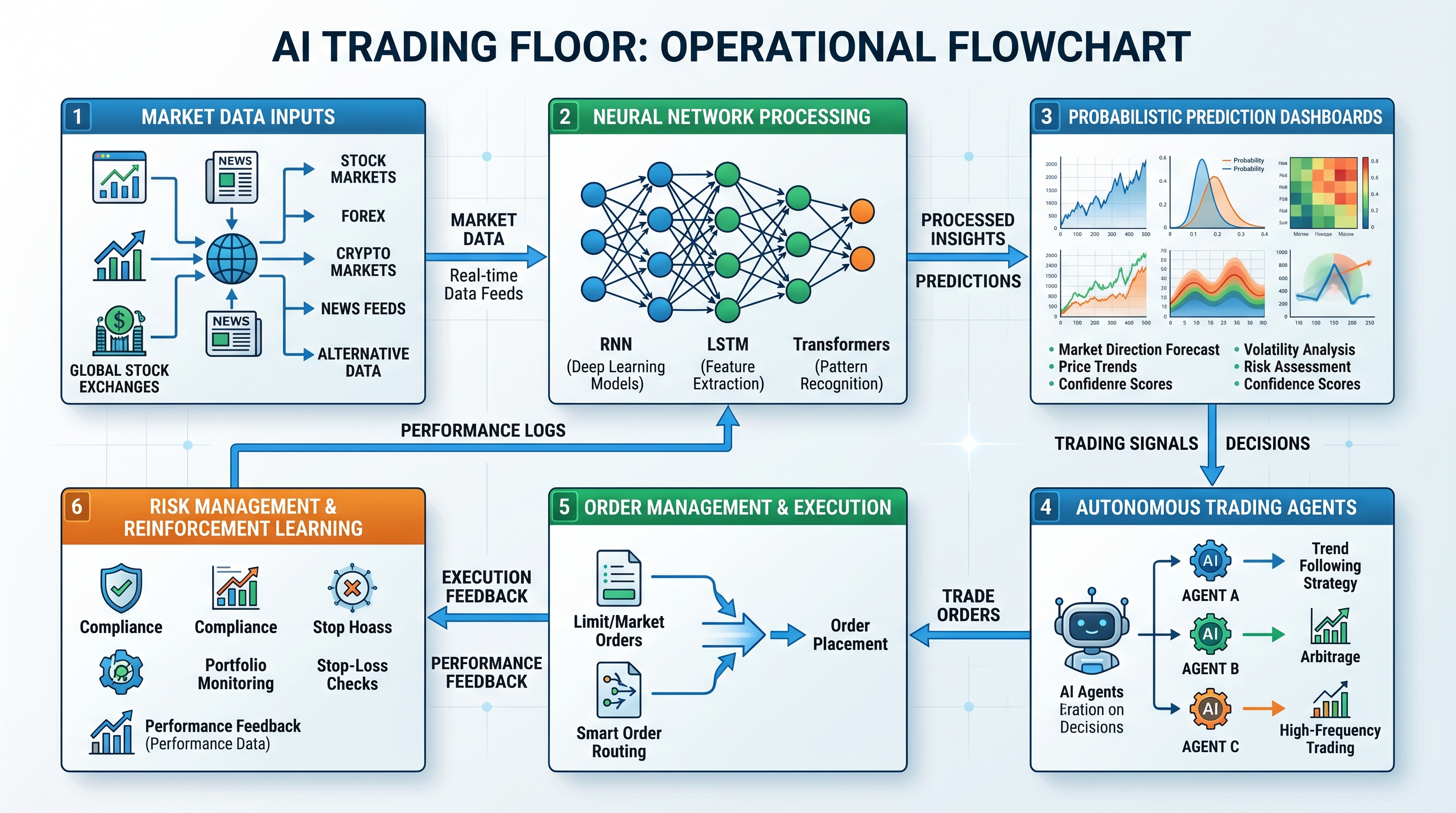
A Practical Multi-Signal Trading Workflow
- Collect diverse market data
- Engineer orthogonal features
- Detect market regime
- Generate independent signals
- Fuse signals using AI
- Calculate confidence score
- Adjust risk dynamically
- Execute trades
- Monitor performance
- Retrain models periodically
This transforms trading from simplistic indicator logic into an adaptive decision engine.
Common Mistakes
- Using too many indicators — noise increases faster than signal
- Ignoring regime changes — strategies optimized for trends fail during consolidation
- Blindly trusting AI — poor data produces poor models regardless of algorithm sophistication
- Optimizing only for returns — Sharpe and Sortino ratios matter more than raw profit
The Future of AI Signal Fusion
The next generation of trading systems is becoming multi-agent, self-adaptive, reinforcement-driven, cross-market aware, and real-time probabilistic. Increasingly, systems no longer ask "Will price go up?" Instead they ask: "What is the probability distribution of future outcomes under current market conditions?" Trading is evolving from deterministic prediction toward probabilistic intelligence.
Key Takeaways
- Single indicators are fragile in changing markets — AI signal fusion combines multiple market perspectives
- Orthogonal signals improve robustness — seek independent dimensions (trend, momentum, volatility, volume, sentiment)
- Machine learning enables adaptive weighting — dynamic allocation based on recent signal performance
- Regime detection dramatically improves performance — different regimes demand different signal configurations
- Probabilistic trading is more realistic than binary prediction — think in confidence scores, not yes/no
- Risk management must be integrated into the model, not bolted on afterward
- Walk-forward validation is essential — one-shot backtests overstate true performance
- Overfitting remains the biggest hidden danger — simplicity and robustness beat complexity and optimization
Conclusion: The Traders Who Adapt Will Survive
Markets reward adaptation. The era of blindly stacking indicators is fading. Modern algorithmic trading increasingly revolves around intelligent systems capable of integrating multiple sources of information simultaneously — exactly what AI signal fusion systems provide.
They do not eliminate uncertainty. Nothing can. But they help traders process complexity more intelligently, manage risk more dynamically, and respond to evolving market conditions with far greater sophistication.
The gap between institutional adaptive probabilistic architectures and retail indicator-based approaches still exists — and that gap creates opportunity. Start simple: build small fusion systems, experiment with feature engineering, test regime-aware models, analyze probabilities instead of certainties. Over time, you'll stop thinking like an indicator user and start thinking like a quantitative system designer. And that shift can completely change your trajectory as an algorithmic trader.