

AI Models That Predict Crypto Markets — What Actually Works and Why
Explore the AI models that actually predict crypto markets — LSTMs, transformers, gradient boosting, and sentiment NLP. Learn the honest strengths and limitations of each architecture with complete Python implementation and real trading insights.
Introduction: The Model That Saw the Crash Coming
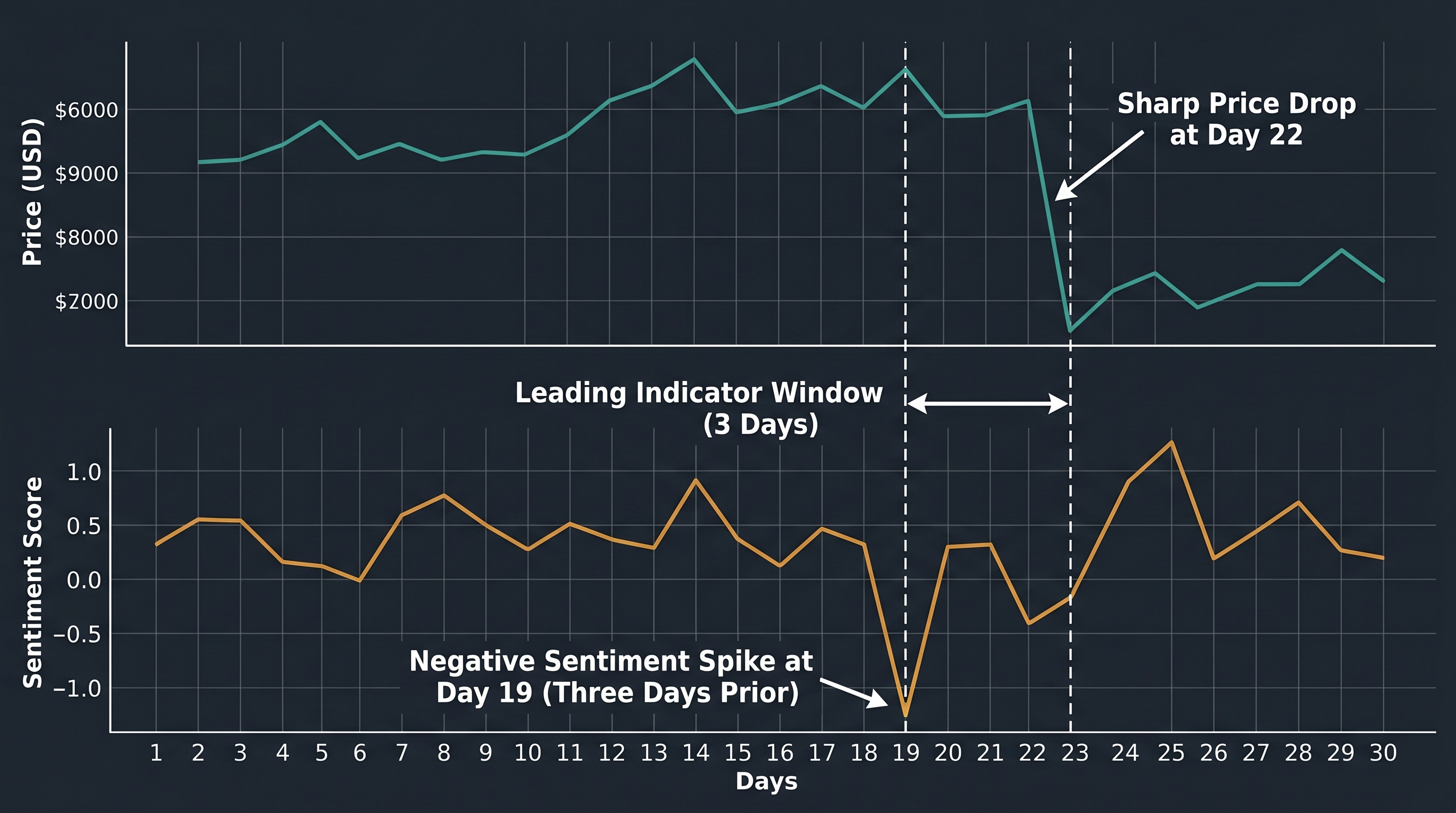
In late 2022, as FTX collapsed and sent shockwaves through the entire crypto market, most traders were caught completely off guard. But a small group of quantitative funds had already reduced their exposure days earlier — not because of insider information, but because their sentiment analysis models had detected an unusual spike in negative language across crypto forums and social media that historically preceded sharp drawdowns.
No chart pattern flagged it. No technical indicator blinked red. An AI model reading text did.
This is the reality of AI-powered crypto trading: the edge is no longer just in price data. It is in processing information faster, from more sources, with more consistency than any human team can manage. And the traders who understand which AI models actually work — and more importantly, why they work — are the ones building strategies that compound quietly while everyone else chases the next narrative.
In this post, you will learn the core AI architectures being applied to crypto market prediction right now, how each one processes market data differently, where each genuinely excels and where each quietly fails, and how to implement a working sequence prediction model in Python.
Why Crypto Is Both a Dream and a Nightmare for AI Models
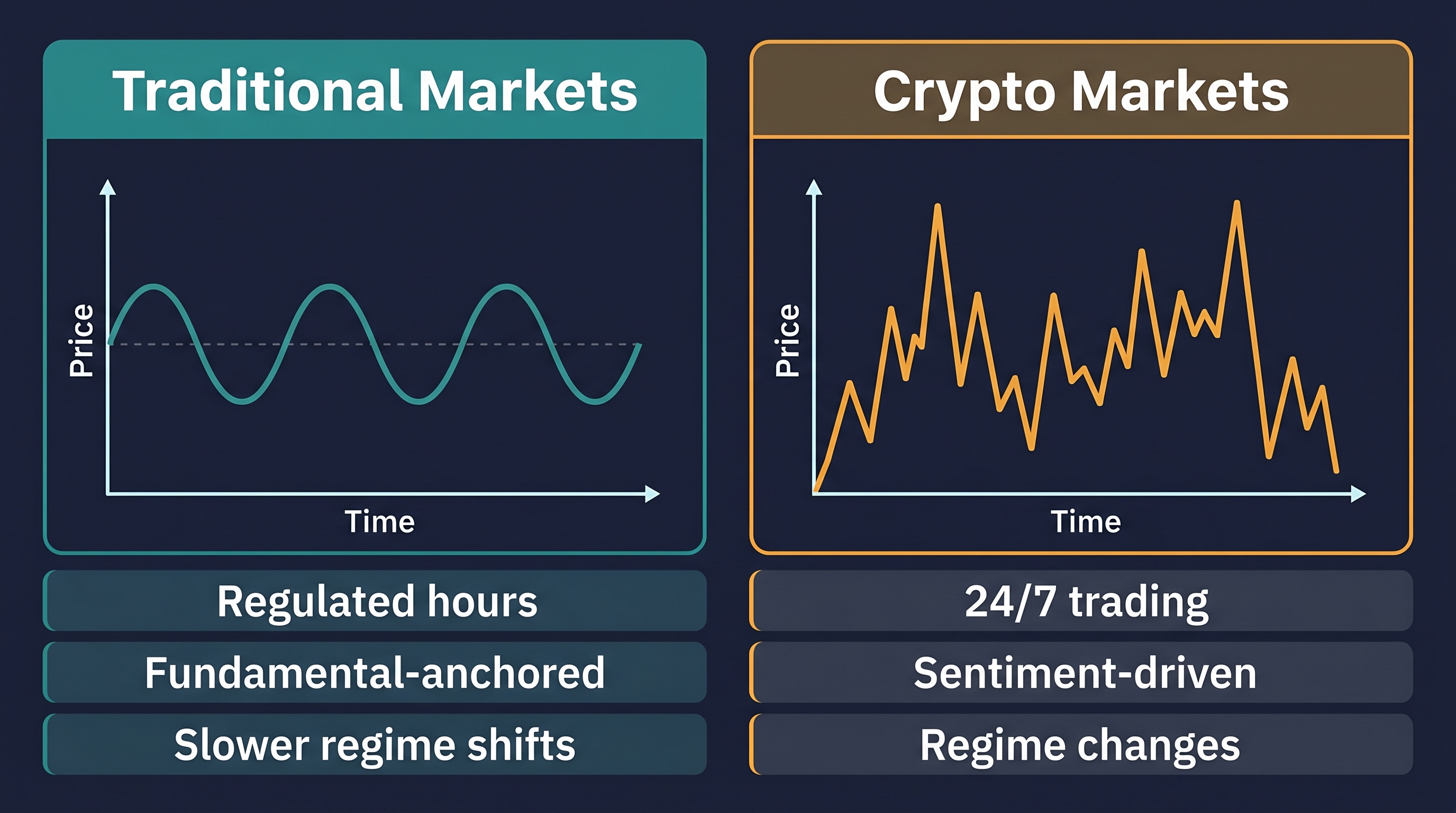
Crypto markets are among the most difficult environments on earth for prediction models. Understanding why is not discouraging — it is essential. It tells you exactly what to demand from any model you build.
Crypto markets operate 24/7, 365 days a year, across hundreds of fragmented exchanges. They are driven by a uniquely volatile cocktail of retail speculation, institutional flows, regulatory headlines, Twitter sentiment, macroeconomic data, and on-chain activity. The signal-to-noise ratio is punishingly low.
And yet — short-horizon inefficiencies persist. Not because crypto is irrational, but because the sheer volume and diversity of information creates temporary imbalances that models can exploit before human traders process and act on the same information. The models that succeed do not predict the future with certainty. They shift probabilities slightly but consistently in their favor, and then position sizing and risk management do the rest.
The Core AI Models Applied to Crypto Price Prediction
LSTM: The Model That Remembers
Standard neural networks process each input independently — they have no memory of what came before. For price prediction, this is a critical limitation. Sequence matters.
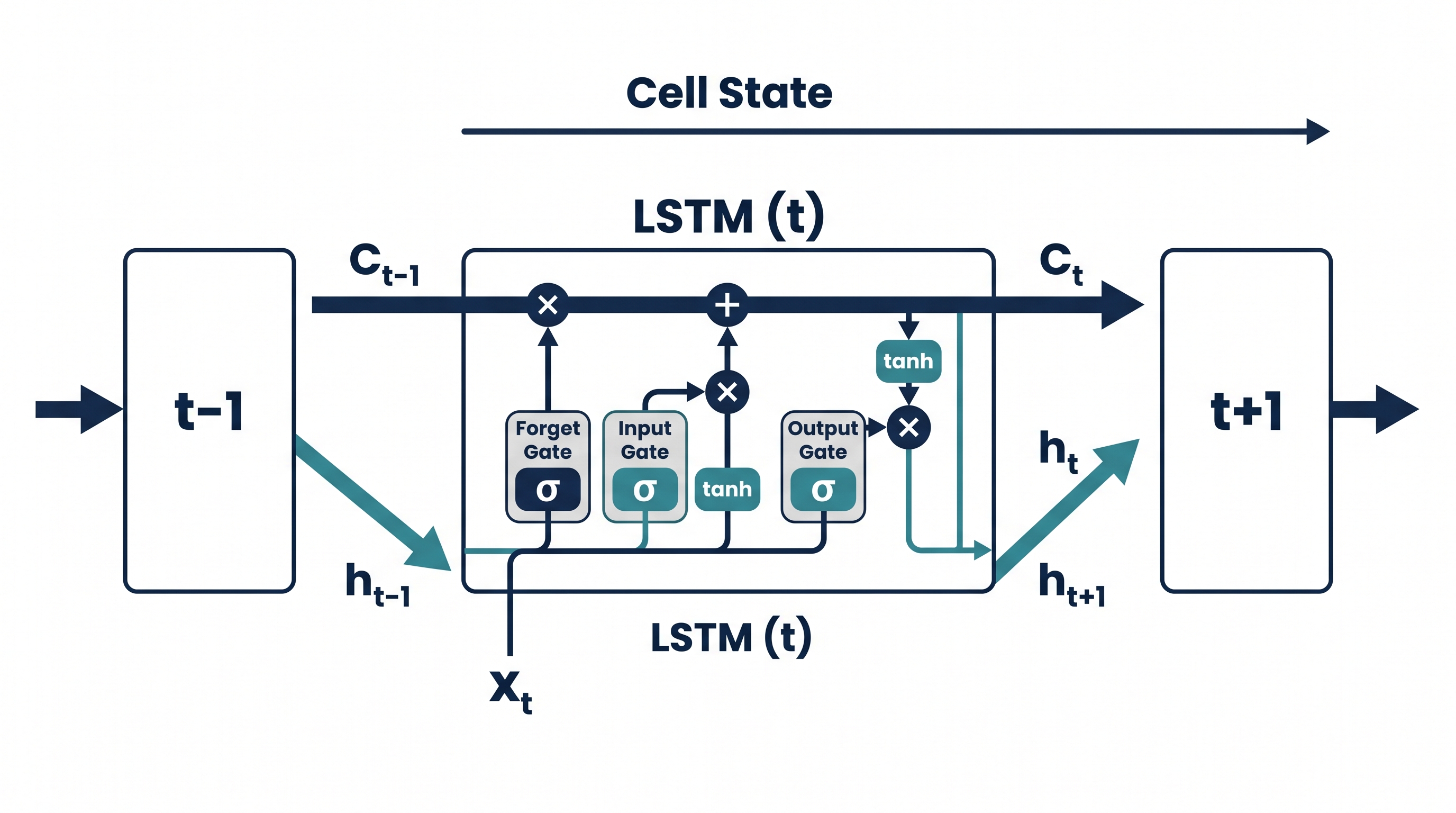
LSTMs solve this by maintaining a hidden state — an internal memory that persists across time steps. At each step, the network decides what to write into memory, what to erase, and what to output. These decisions are governed by three learned gates:
Forget Gate: — decides what fraction of previous memory to retain
Input Gate: , — decides what new information to add
Output Gate: , — decides what to output
Where is the hidden state, is the current input, is the cell state (memory), and and are learned weights and biases. In plain English: the LSTM learns which parts of market history are worth remembering and which are noise. That learned selectivity is precisely what makes it useful for financial sequences.
Transformer Models: Attention Without Sequence Bottlenecks
LSTMs process sequences step by step, creating a bottleneck: information from early in the sequence must be compressed through every subsequent step. For very long sequences, this degrades signal quality.
Transformers solve this with self-attention, allowing the model to directly compare every time step to every other time step simultaneously:
Where (queries), (keys), and (values) are linear projections of the input, and is the key dimension. The scaling prevents dot products from growing too large.
In trading terms: a transformer applied to 90 days of price data can directly learn that "conditions on day 3 are highly relevant to predicting day 87" without carrying that information through 84 intermediate steps. Recent research has shown transformers outperforming LSTMs on crypto prediction tasks with longer lookback windows.
Gradient Boosting: The Surprisingly Competitive Baseline
XGBoost and LightGBM are the quietly dominant workhorses of production quantitative trading. Multiple industry surveys consistently find gradient boosted trees outperforming deep learning on tabular financial data. The prediction:
Where is the -th tree, is the total number of trees, and is the learning rate. The reason gradient boosting often beats deep learning comes down to data efficiency: LSTMs and transformers require substantial data; gradient boosting achieves strong performance with far fewer samples — critical in crypto where certain market regimes have limited historical examples.
Sentiment Models: The Hidden Information Layer
Modern sentiment models use pre-trained transformer architectures (FinBERT) to classify social media posts, news headlines, and forum discussions, then aggregate into a quantitative sentiment score:
Where is the sentiment score of the -th document (-1 to +1), is a recency or source-credibility weight, and is the total number of documents. Spikes in negative sentiment — particularly when diverging from price action — have historically been leading indicators of drawdowns in Bitcoin and major altcoins.
Building an LSTM Price Prediction Model in Python
Step 1: Data Preparation and Feature Scaling
1import numpy as np
2import pandas as pd
3from sklearn.preprocessing import MinMaxScaler
4from tensorflow.keras.models import Sequential
5from tensorflow.keras.layers import LSTM, Dense, Dropout
6from tensorflow.keras.callbacks import EarlyStopping
7
8df = pd.read_csv('btc_daily.csv', parse_dates=['timestamp'], index_col='timestamp')
9df = df[['close', 'volume']].dropna()
10
11# Scale features to [0, 1] — critical for LSTM stability
12scaler = MinMaxScaler()
13scaled = scaler.fit_transform(df)
Scaling is not optional with LSTMs. The sigmoid and tanh activation functions inside LSTM gates saturate at extreme values, killing gradient flow. MinMaxScaler compresses all values into [0, 1], keeping activations in the sensitive, informative region.
Step 2: Create Sequence Windows
1def create_sequences(data, lookback=30):
2    X, y = [], []
3    for i in range(lookback, len(data)):
4        X.append(data[i - lookback:i])   # Past 30 days as input
5        y.append(data[i, 0])             # Next day's close as target
6    return np.array(X), np.array(y)
7
8lookback = 30
9X, y = create_sequences(scaled, lookback)
10
11# Chronological train/test split — never shuffle time-series data
12split = int(len(X) * 0.8)
13X_train, X_test = X[:split], X[split:]
14y_train, y_test = y[:split], y[split:]
Each input sample is a window of 30 consecutive days; the label is the closing price on day 31. The 80/20 split is strictly chronological — future data never contaminates training.
Step 3: Build and Train the LSTM
1model = Sequential([
2    LSTM(64, return_sequences=True, input_shape=(lookback, X.shape[2])),
3    Dropout(0.2),
4    LSTM(32, return_sequences=False),
5    Dropout(0.2),
6    Dense(1)
7])
8
9model.compile(optimizer='adam', loss='mean_squared_error')
10
11early_stop = EarlyStopping(monitor='val_loss', patience=10, restore_best_weights=True)
12
13history = model.fit(
14    X_train, y_train,
15    epochs=100,
16    batch_size=32,
17    validation_split=0.1,
18    callbacks=[early_stop],
19    verbose=1
20)
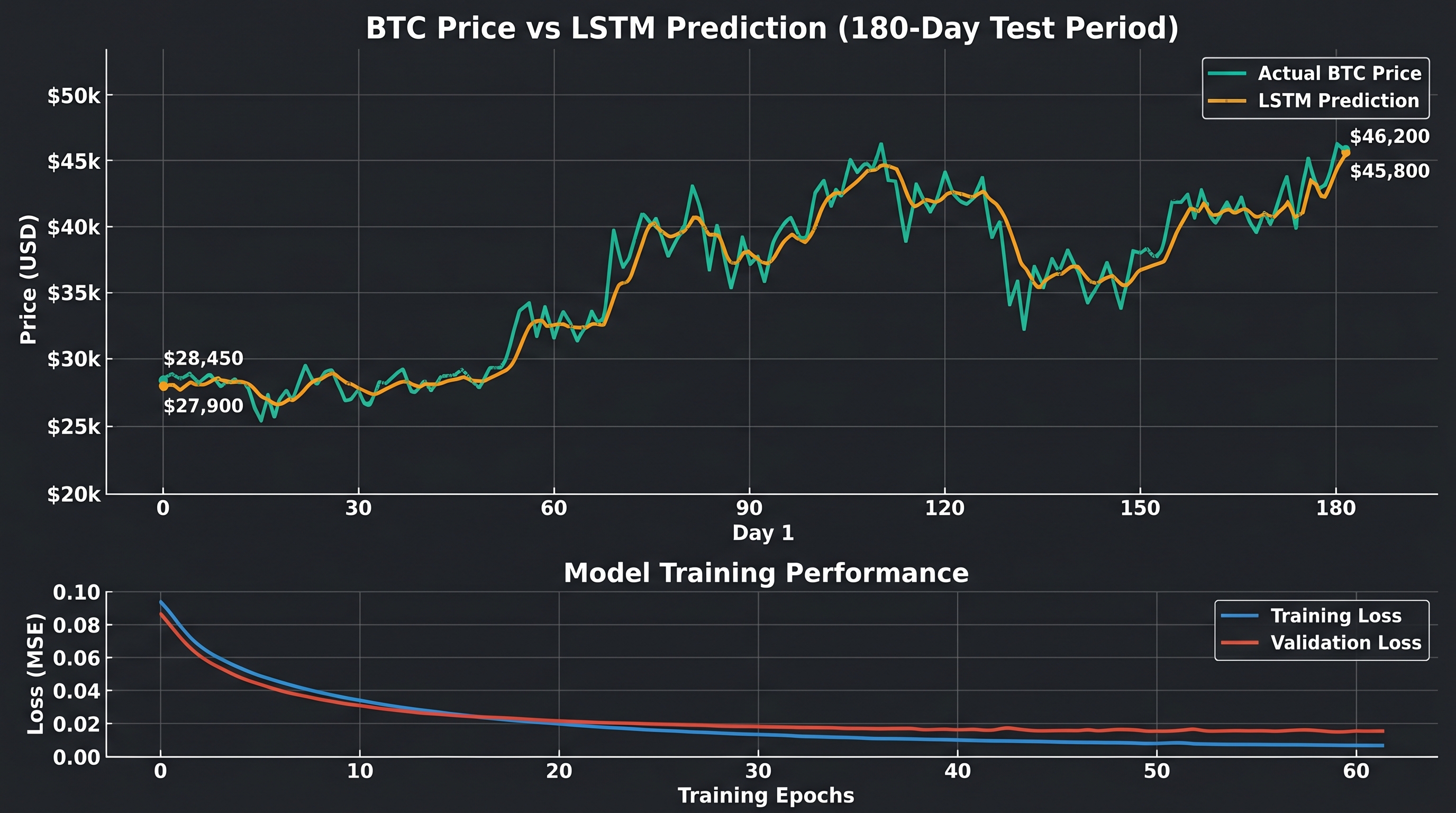
Two stacked LSTM layers allow the network to learn features at different abstraction levels. Dropout (0.2) randomly deactivates 20% of neurons during training, forcing redundant representations and reducing overfitting. Early stopping halts training when validation loss stops improving.
Step 4: Evaluate and Inverse Transform
1predictions_scaled = model.predict(X_test)
2
3pred_full = np.zeros((len(predictions_scaled), scaled.shape[1]))
4pred_full[:, 0] = predictions_scaled[:, 0]
5
6actual_full = np.zeros((len(y_test), scaled.shape[1]))
7actual_full[:, 0] = y_test
8
9predictions = scaler.inverse_transform(pred_full)[:, 0]
10actuals = scaler.inverse_transform(actual_full)[:, 0]
11
12rmse = np.sqrt(np.mean((predictions - actuals) ** 2))
13print(f"RMSE: ${rmse:,.2f}")
The Root Mean Squared Error:
Where is predicted price and is actual price. RMSE alone is insufficient for evaluating a trading strategy — what ultimately matters is risk-adjusted return, not prediction accuracy in dollar terms.
Honest Limitations: What These Models Cannot Do
LSTMs suffer from vanishing gradients on very long sequences. Despite gating mechanisms, LSTMs struggle to reliably carry information across sequences longer than a few hundred time steps — for daily crypto data, beyond roughly six months.
Transformers are data-hungry. Self-attention requires substantial data to learn meaningful relationships. With crypto's relatively short historical record, transformers risk overfitting unless carefully regularized.
All models are regime-blind by default. A model trained in a bull market learns bull market patterns. When the regime shifts, those patterns may invert entirely. Without explicit regime detection, your AI can confidently predict the wrong direction.
Sentiment models degrade rapidly. Crypto community language evolves constantly — slang, memes, and irony make NLP classification significantly harder than in traditional financial text. A model trained in 2021 may interpret 2024 crypto Twitter very differently.
The appropriate response is not to abandon AI models — it is to build systems that monitor model performance in real time and trigger retraining or position reduction when performance degrades.
Key Takeaways
- LSTMs learn sequential dependencies through learned memory gates — suitable for short-to-medium-term temporal patterns in crypto
- Transformers use self-attention to compare all time steps simultaneously — outperforming LSTMs on longer lookback windows
- Gradient boosted models frequently outperform deep learning on tabular crypto data with engineered features, particularly with limited training data
- Sentiment AI models using NLP act as leading indicators — detecting crowd psychology shifts before they fully manifest in price
- No AI model eliminates prediction uncertainty — models shift probabilities incrementally; position sizing and risk management determine profitability
- Regime awareness, periodic retraining, and real-time monitoring are non-negotiable for deploying AI models in live crypto trading
Conclusion: The Edge Is in the Process, Not the Model
After reading this far, you now understand something that most retail crypto traders will never take the time to learn: the model itself is not the edge. The edge is in the process — disciplined feature engineering, honest evaluation methodology, regime awareness, willingness to retrain when markets change, and risk management that protects capital while the model learns.
The traders who will dominate the next cycle of crypto markets are not the ones who find the "magic" model. They are the ones who build robust pipelines that process information systematically, evaluate themselves honestly, and adapt continuously.
You have the conceptual foundation now. The LSTM code in this post runs on any daily OHLCV dataset from Binance, Kraken, or CoinGecko. Start there. Run it. Break it intentionally — remove dropout, expand the feature set, shorten the training window — and watch what happens to your validation loss. Each experiment teaches you something a blog post cannot.
The market does not reward the most confident trader. It rewards the most prepared one.