

AI Based Crypto Trading Strategy for Smarter Decisions
Build a complete AI-powered crypto trading system using Random Forest machine learning. Learn feature engineering from price, volume, and volatility data, model training and evaluation, overfitting prevention, and the critical difference between prediction accuracy and trading profitability.
Introduction
For years, traders believed profitable trading depended on experience, intuition, and screen time. Then artificial intelligence changed everything.
Today, AI systems can analyze massive amounts of market data, detect hidden trading patterns, react faster than humans, filter emotional decisions, and adapt to changing market conditions. And nowhere is this transformation happening faster than in crypto markets.
Crypto trading produces enormous amounts of data every second: price movement, volume spikes, volatility changes, sentiment shifts, and order flow behavior. Human traders struggle to process all of this consistently. AI does not. That is why AI-based crypto trading strategies are becoming one of the most important developments in algorithmic trading.
But there is a major misunderstanding beginners often have. AI trading is not magic. It does not guarantee profits. And simply adding machine learning to a strategy does not automatically make it smarter. The real power of AI comes from improving pattern recognition, decision-making, signal filtering, risk management, and market adaptability.
In this guide, you will learn: what AI trading actually means, how machine learning works in crypto markets, core components of AI trading systems, feature engineering for trading models, trend and momentum detection, AI-based signal filtering, risk management techniques, Python examples for machine learning trading systems, and common mistakes beginner AI traders make.
What Is an AI-Based Crypto Trading Strategy?
An AI-based trading strategy uses machine learning or data-driven algorithms to make trading decisions. Instead of relying only on fixed indicator rules, AI systems learn patterns from historical data. These systems can predict probabilities, detect momentum shifts, classify market conditions, and filter low-quality trades.
The goal is not a perfect prediction. The goal is improving probability and decision quality.
Why AI Works Well in Crypto Markets
Crypto markets are ideal for AI systems because they generate high volatility, massive data flow, repeating behavioral patterns, and strong momentum cycles. AI models excel in environments with large datasets, nonlinear relationships, and frequent market activity. Crypto markets provide exactly that. Unlike traditional markets, crypto trades continuously 24 hours a day — creating endless opportunities for pattern detection, momentum analysis, and statistical learning.
The Biggest Misconception About AI Trading
Many beginners believe AI can predict markets perfectly. That is unrealistic. Markets are influenced by human emotion, news events, liquidity shocks, and macroeconomic conditions. AI systems cannot eliminate uncertainty. What they can do is improve signal quality, reduce emotional bias, detect subtle relationships, and adapt faster than manual traders. That difference matters enormously.
Machine Learning vs Traditional Trading Systems
Traditional algorithmic strategies follow fixed rules (e.g., buy when EMA 50 crosses above EMA 200, sell when RSI falls below 40). Machine learning systems behave differently — they learn relationships from data automatically. Instead of explicitly coding every rule, the model discovers patterns statistically. This creates flexibility. But it also creates complexity.
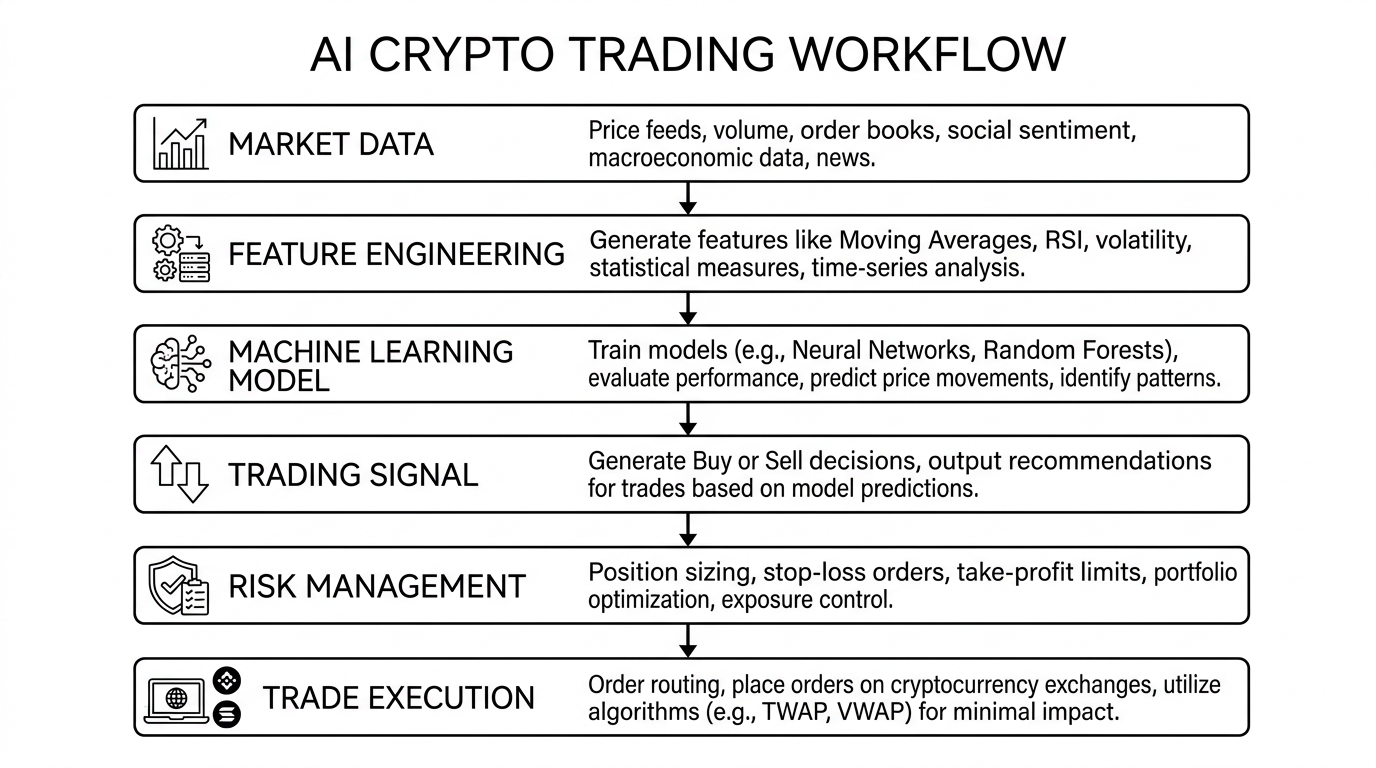
Feature Engineering Is the Real Edge
Most beginner AI traders focus too heavily on model selection. In reality, feature engineering matters more. Features are inputs used by the machine learning model. Examples include RSI, MACD, ATR, volume, price returns, volatility, and moving averages.
These features help AI systems understand market behavior.
Trend Detection Using AI
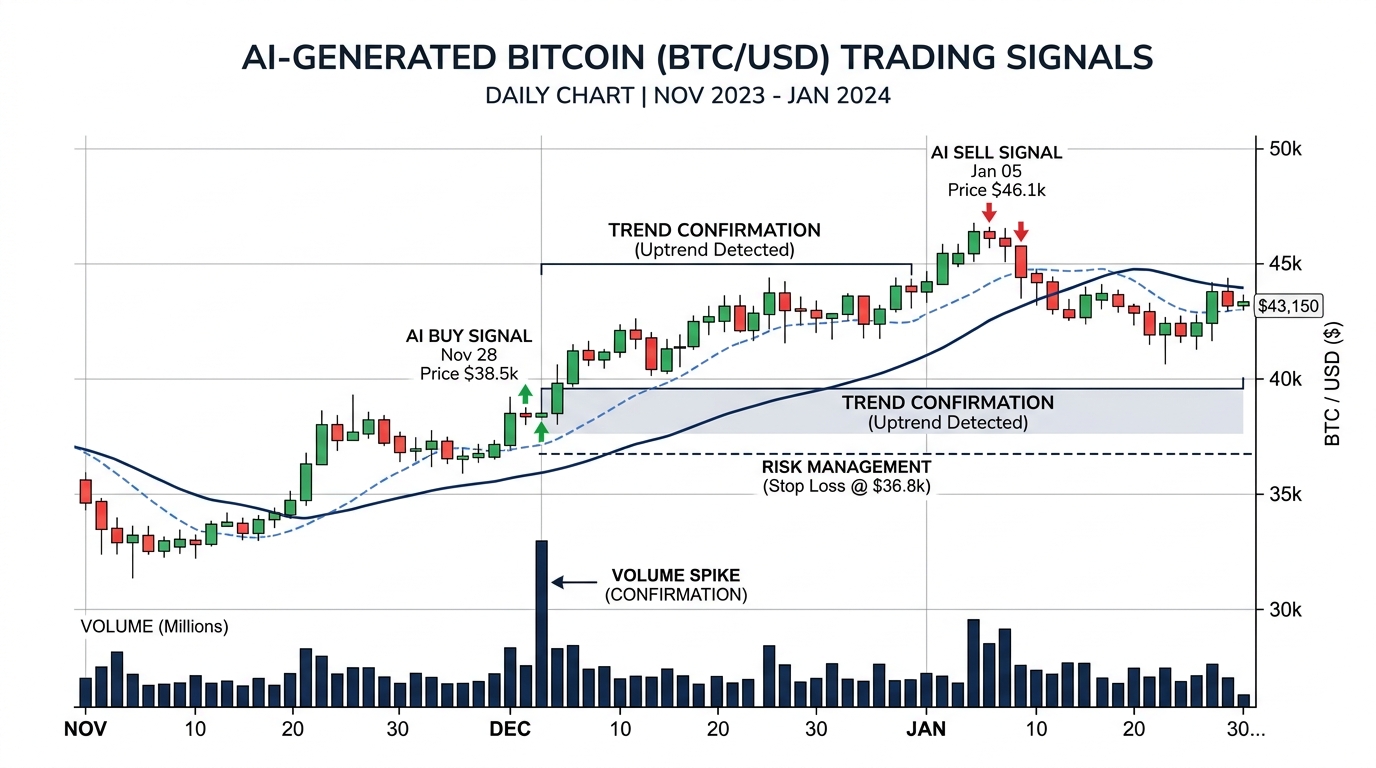
Trend identification remains critical even in AI systems. Many models include moving averages as features. The EMA formula: . A bullish trend condition: . AI models often use this information as part of broader decision-making.
Momentum Features Improve AI Predictions
Momentum indicators help AI systems identify directional strength. RSI formula: . AI models may use RSI to detect momentum expansion, identify overextended conditions, and filter weak trends. Momentum data improves prediction quality significantly.
Volume Analysis Matters for AI Trading
Volume often reveals hidden market participation. AI systems frequently include volume-based features. A common volume confirmation: . Higher volume often supports stronger momentum, better breakout reliability, and increased market participation. This helps models avoid weak signals.
ATR Helps AI Systems Adapt to Volatility
Crypto volatility changes constantly. ATR allows AI systems to measure volatility dynamically: . Higher ATR values indicate larger price movement, higher uncertainty, and increased market volatility. AI systems often adjust position size, stop distance, and trade frequency based on ATR conditions.
Risk Management Remains Essential
AI does not eliminate trading risk. Risk management still determines long-term survival. Position sizing: . Even highly advanced systems require disciplined risk control.
Building a Simple AI Crypto Trading Model in Python
1import pandas as pd
2import numpy as np
3import yfinance as yf
4from sklearn.model_selection import train_test_split
5from sklearn.ensemble import RandomForestClassifier
6from sklearn.metrics import accuracy_score
7
8df = yf.download("BTC-USD", start="2022-01-01")
9
10# Creating Technical Features
11df['Return'] = df['Close'].pct_change()
12df['EMA50'] = df['Close'].ewm(span=50, adjust=False).mean()
13df['EMA200'] = df['Close'].ewm(span=200, adjust=False).mean()
14df['Volume_MA'] = df['Volume'].rolling(window=20).mean()
15
16# Creating the Prediction Target
17df['Target'] = np.where(df['Close'].shift(-1) > df['Close'], 1, 0)
18# 1 = price moves higher next period, 0 = price moves lower next period
19
20# Preparing Data for Machine Learning
21df = df.dropna()
22features = ['Return', 'EMA50', 'EMA200', 'Volume_MA']
23X = df[features]
24y = df['Target']
25
26# Training the AI Model
27X_train, X_test, y_train, y_test = train_test_split(
28    X, y, test_size=0.2, shuffle=False
29)
30
31model = RandomForestClassifier(n_estimators=100, random_state=42)
32model.fit(X_train, y_train)
33
34# Evaluating Prediction Accuracy
35predictions = model.predict(X_test)
36accuracy = accuracy_score(y_test, predictions)
37print(f"Model Accuracy: {accuracy:.2f}")
Random Forest models are popular because they handle nonlinear patterns, reduce overfitting, and work well with trading data. However, trading profitability matters more than prediction accuracy alone.
Why Backtesting Is Critical
Many AI trading systems fail because traders skip rigorous testing. Backtesting helps evaluate historical performance, drawdowns, win rate, and risk-adjusted returns. Without testing, AI systems become dangerous — especially in highly volatile crypto environments.
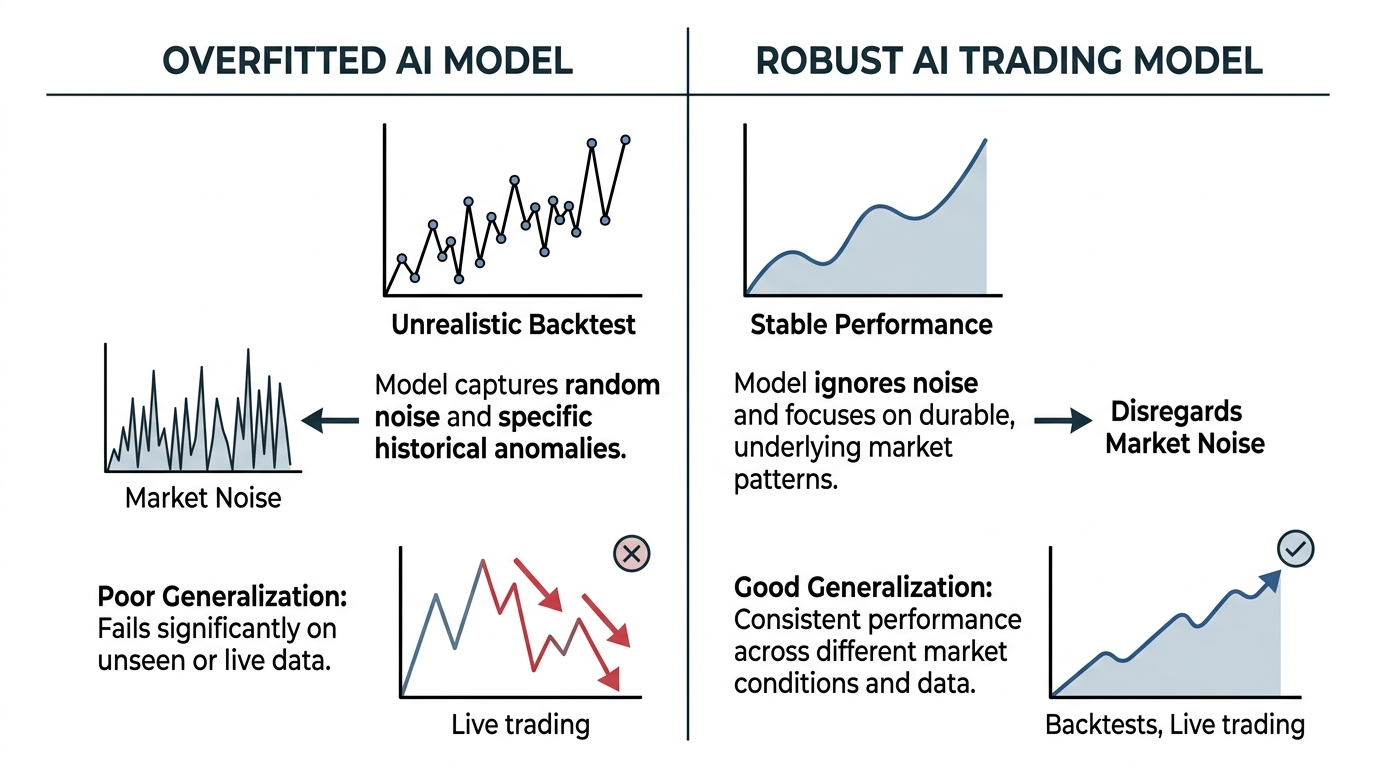
Overfitting Is the Biggest AI Trading Risk
One of the most dangerous problems in machine learning trading is overfitting. Overfitting happens when models memorize historical noise instead of learning useful patterns. This creates excellent backtests and terrible live performance. Professional traders focus heavily on simplicity, robustness, and out-of-sample testing rather than maximizing historical accuracy.
Why AI Cannot Replace Human Judgment Completely
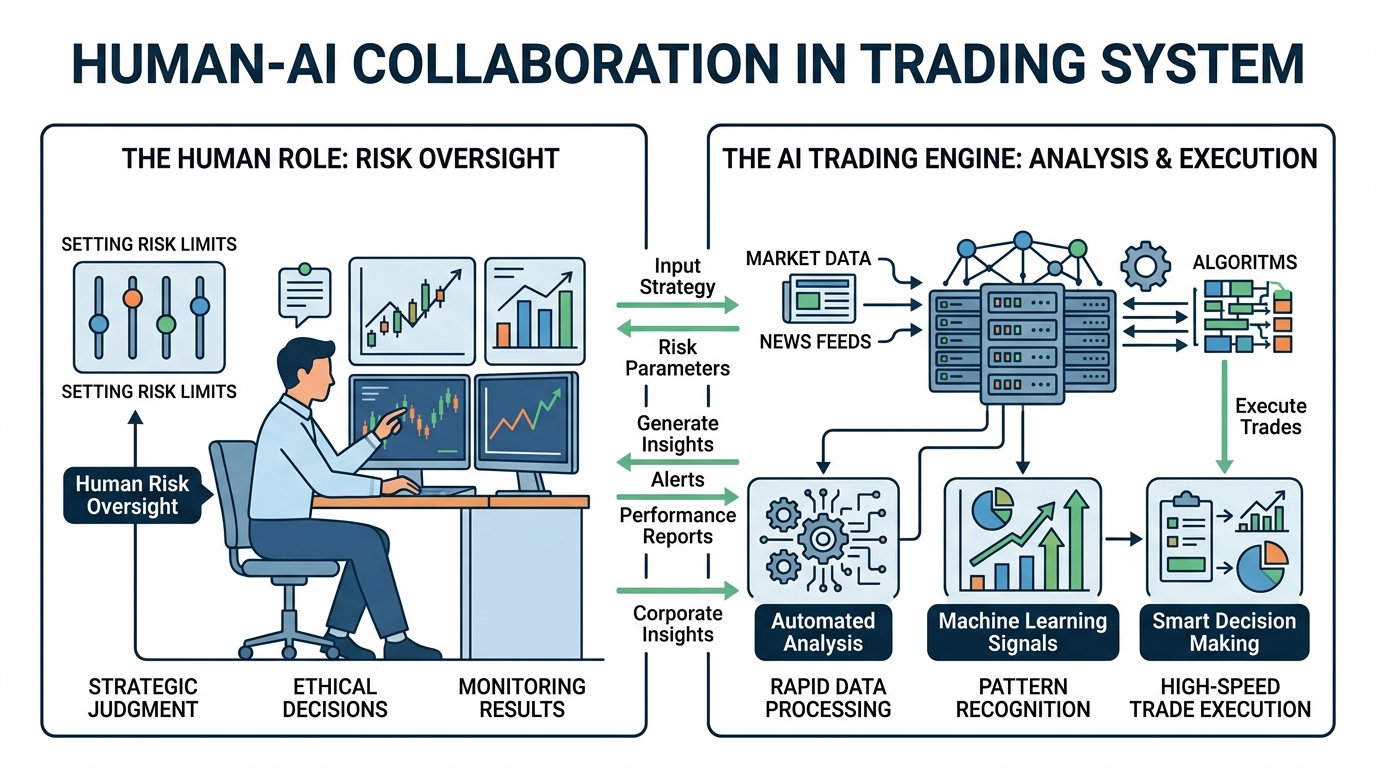
Even advanced AI systems have limitations. AI models struggle with sudden news shocks, black swan events, regulatory surprises, and extreme market panic. Human oversight still matters. The best AI traders combine quantitative systems, market understanding, risk management, and strategic thinking. This hybrid approach is often strongest.
Common AI Trading Mistakes Beginners Make
- Using too many indicators — more features do not always improve models; complexity can increase noise
- Ignoring risk management — AI systems still experience losses; risk control remains essential
- Trusting accuracy alone — high prediction accuracy does not guarantee profitability; risk-adjusted returns matter more
- Overfitting historical data — over-optimized systems often collapse in live markets; robustness matters more than perfection
- Ignoring market regimes — crypto markets behave differently during bull markets, bear markets, and sideways conditions; AI systems must adapt
Advanced AI Trading Concepts
More advanced AI trading systems may include deep learning, reinforcement learning, natural language processing, sentiment analysis, and order flow prediction. However, beginners should start simple. A strong foundation matters far more than sophisticated buzzwords.
Key Takeaways
- AI trading systems use machine learning to improve decision-making in crypto markets
- Feature engineering matters more than complex models
- Trend, momentum, volume, and volatility data improve AI predictions
- ATR-based risk management helps adapt to changing volatility conditions
- Backtesting is essential before deploying live AI strategies
- Overfitting is one of the biggest dangers in machine learning trading
- AI improves probability and consistency rather than guaranteeing profits
- Human oversight remains important even with advanced automation
Final Thoughts
AI is transforming crypto trading rapidly. But the real advantage is not artificial intelligence alone. It is disciplined intelligence. Successful AI trading systems combine data analysis, statistical learning, risk management, market understanding, and structured execution.
The future of algorithmic trading will likely belong to traders who understand both financial markets and intelligent systems. And importantly: the traders who survive long term will not necessarily be the ones with the most complicated AI models. They will be the ones who build robust systems, disciplined risk management, adaptive strategies, and consistent execution frameworks.
If you are serious about improving your crypto trading skills: learn Python deeply, study machine learning fundamentals, focus on feature engineering, backtest extensively, and prioritize robustness over hype. Because in modern markets, smarter decisions often create a stronger edge than faster decisions.