

AI Assisted Trading Setup for Smarter Crypto Entries
Build an AI-assisted crypto trading setup with machine learning and Python. Learn feature engineering, logistic regression models, momentum detection, signal confirmation, risk management, and how to combine AI with traditional indicators for smarter entries.
Introduction
The biggest myth in crypto trading is that successful traders predict the future. They do not.
The best traders build systems that react faster, filter noise better, and make smarter decisions under pressure. That is exactly why AI-assisted trading has exploded across crypto markets. While retail traders stare at charts emotionally, AI-driven systems quietly analyze volatility, momentum, liquidity, market structure, and probability in real time.
But here is the surprising part: AI does not replace traders. It amplifies disciplined decision-making. You do not need a hedge fund server farm or a PhD in machine learning to build an intelligent trading setup. With Python, market data APIs, and a structured strategy framework, you can create AI-assisted systems that improve entries and reduce emotional mistakes.
In this guide, you will learn:
- What AI-assisted trading actually means in practice
- How AI improves crypto entries through layered filtering
- Which indicators work best with machine learning
- How to structure a smart crypto trading setup
- Python examples for building trading models
- Common mistakes traders make with AI strategies
What Is AI Assisted Trading?
AI-assisted trading uses machine learning or intelligent rule-based systems to improve trading decisions. The key word is assisted — the AI does not blindly control your account. Instead, it helps identify high-probability setups, momentum shifts, trend reversals, volatility conditions, risk-adjusted entries, and market anomalies.
Think of AI as a filtering engine. Instead of manually scanning dozens of crypto charts, your system analyzes market conditions automatically and highlights opportunities matching your strategy rules. This is especially valuable in crypto because markets operate 24/7 with extremely high volatility — human attention cannot compete with machine speed.
Why AI Matters in Crypto Markets
Crypto markets are faster, more emotional, more volatile, more momentum-driven, and highly reactive to news and liquidity. A traditional trader may miss sudden shifts in momentum. AI systems detect these changes instantly.
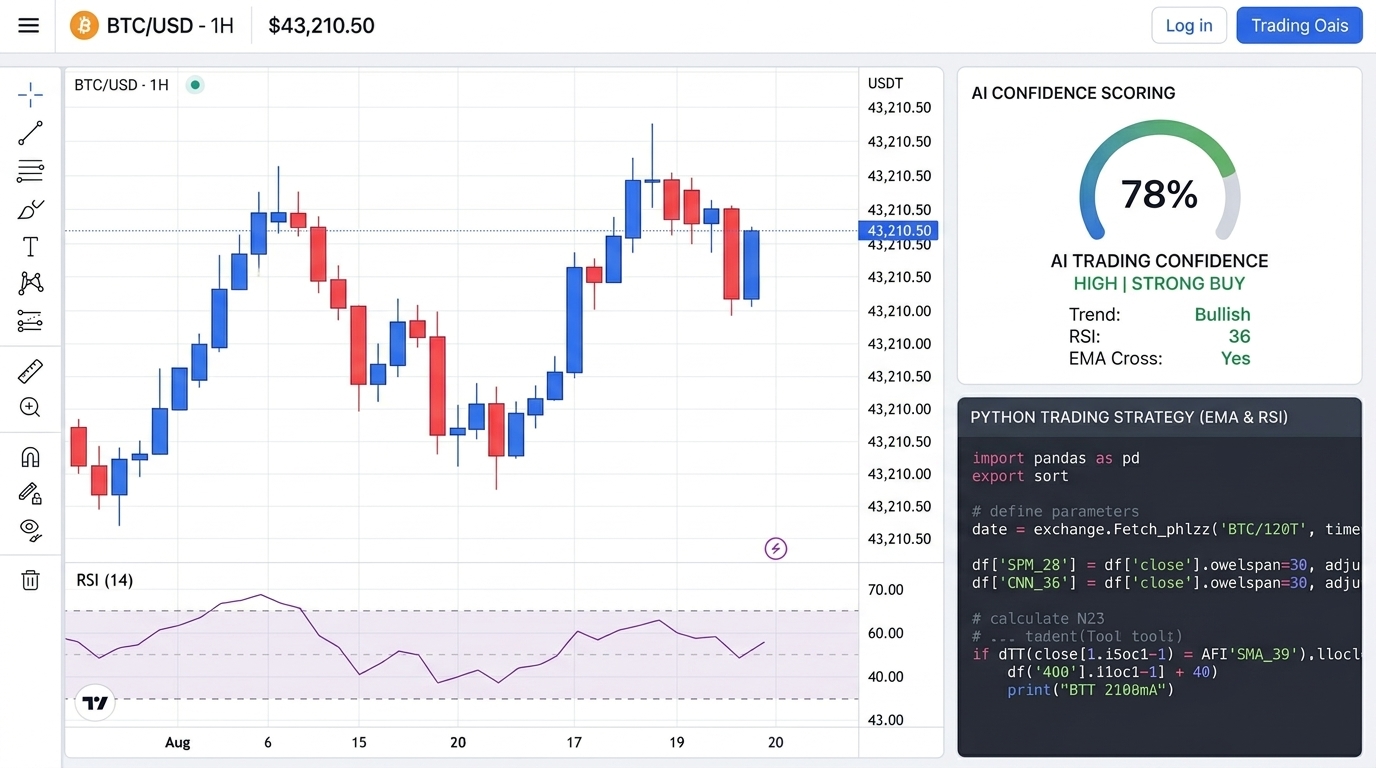
When Bitcoin volatility spikes, volume suddenly increases, RSI exits oversold, order flow turns bullish, and price breaks resistance simultaneously — an AI-assisted system combines these signals into a single confidence score, allowing traders to focus only on high-quality setups.
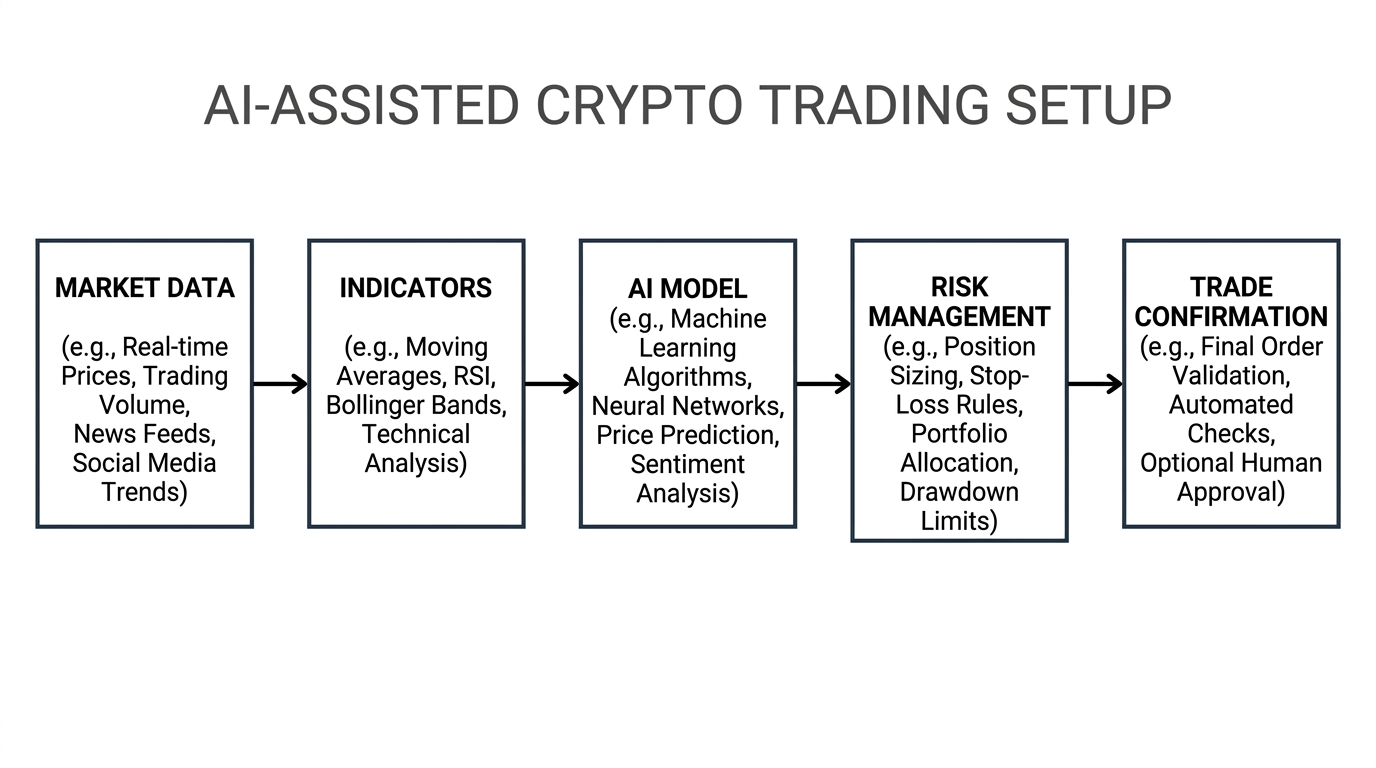
The Core Components of an AI Trading Setup
1. Market Data Collection
Your system needs reliable data: OHLCV candles, volume, funding rates, open interest, order book data, social sentiment, and volatility metrics. Without clean data, even advanced AI models fail.
2. Feature Engineering
Transform raw market data into meaningful trading signals: RSI values, EMA crossovers, ATR volatility, momentum scores, volume spikes, and trend strength measures.
3. AI/ML Model
Popular models include logistic regression, random forests, gradient boosting, neural networks, and reinforcement learning. For beginners, simpler models often work better — complex models easily overfit market noise.
4. Signal Confirmation Engine
AI output should never be used blindly. Add rule-based confirmation: trend direction, support/resistance, volume confirmation, and volatility filters. This dramatically improves signal quality.
5. Risk Management Layer
Even highly accurate AI systems lose money without risk control. Define position size, maximum daily loss, stop-loss distance, profit targets, and volatility adjustments:
Position_Size = Risk_Per_Trade / Stop_Distance
Building a Smarter Crypto Entry System
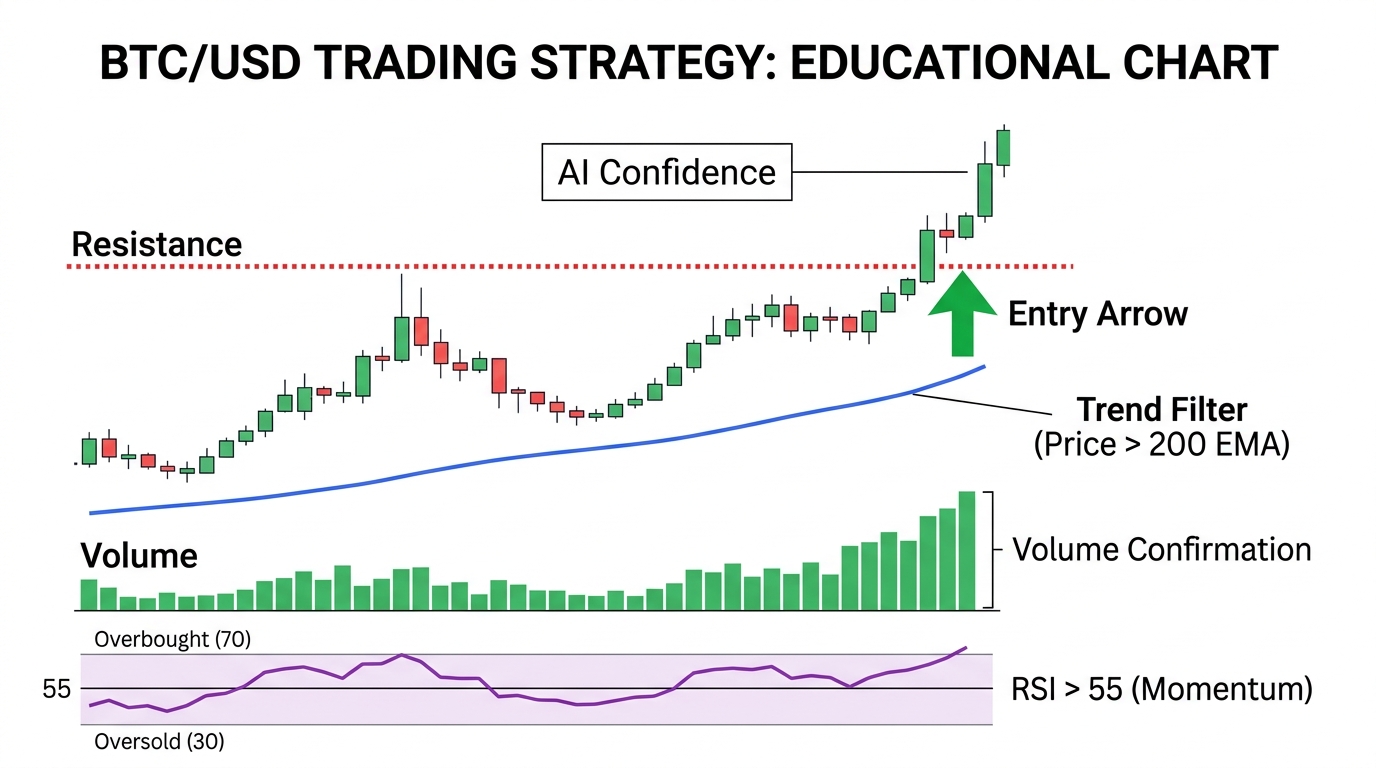
A strong AI-assisted entry combines trend analysis, momentum confirmation, volatility filtering, volume expansion, and machine learning prediction. A bullish entry may require: price above 200 EMA, RSI above 55, volume spike, positive AI confidence score, and breakout confirmation — creating confluence instead of relying on a single signal.
Using AI for Momentum Detection
AI helps identify momentum before the crowd reacts by combining rate of change, relative volume, volatility expansion, and moving average slope:
Volatility_Ratio = ATR_current / ATR_average
When volatility increases alongside momentum, breakout probability rises — especially useful for Bitcoin scalping, altcoin breakouts, and intraday trading.
Machine Learning vs Traditional Indicators
AI works best combined with traditional analysis — not replacing it. Indicators provide structured information; AI interprets relationships between them. RSI oversold + MACD bullish crossover + increasing volume → AI analyzes whether similar conditions historically led to profitable trades. This creates probability-based decision-making instead of emotional trading.
Example Python AI Trading Setup
1import pandas as pd
2import numpy as np
3from sklearn.linear_model import LogisticRegression
4from sklearn.model_selection import train_test_split
5
6# Load data
7df = pd.read_csv("btc_data.csv")
8
9# Calculate EMA
10df["ema_50"] = df["Close"].ewm(span=50).mean()
11
12# RSI calculation
13delta = df["Close"].diff()
14gain = np.where(delta > 0, delta, 0)
15loss = np.where(delta < 0, abs(delta), 0)
16avg_gain = pd.Series(gain).rolling(14).mean()
17avg_loss = pd.Series(loss).rolling(14).mean()
18rs = avg_gain / avg_loss
19df["RSI"] = 100 - (100 / (1 + rs))
20
21# Create target variable
22df["target"] = np.where(
23    df["Close"].shift(-1) > df["Close"], 1, 0
24)
25
26# Features and target
27X = df[["RSI", "ema_50"]].dropna()
28y = df["target"].iloc[-len(X):]
29
30# Split and train
31X_train, X_test, y_train, y_test = train_test_split(
32    X, y, test_size=0.2, random_state=42
33)
34model = LogisticRegression()
35model.fit(X_train, y_train)
36predictions = model.predict(X_test)
Real systems include more features, better validation, risk controls, position management, and walk-forward testing. This framework introduces the core idea.
The Importance of Feature Selection
Most beginners feed too many indicators into the model — more is not better. High-quality features are relevant, non-redundant, interpretable, and consistent: RSI divergence, ATR expansion, volume imbalance, EMA slope, breakout strength. Focus on quality over quantity.
Combining AI With Market Structure
AI becomes far more effective when combined with price action logic. Require bullish market structure, higher highs, higher lows, positive momentum, and AI confidence above threshold. The higher the combined score across trend, momentum, and volume dimensions, the stronger the trade setup.
Risk Management for AI Trading Systems
AI systems can still fail — crypto markets are unpredictable. Use volatility-adjusted stops:
Stop_Loss = ATR × k
Risk only 1% per trade. Consistency matters more than short-term excitement. Even accurate systems experience losing streaks.
Common AI Trading Mistakes
Overfitting Historical Data
Perfect backtest performance often means the model learned noise, not signal. Markets evolve — overfit models don't.
Ignoring Transaction Costs
Frequent trading increases fees, slippage, and spread costs. These destroy marginal edges.
Blind Trust in AI
AI is a decision-support tool, not magic. Human oversight still matters.
Using Too Much Leverage
Even accurate systems have losing streaks. High leverage amplifies destruction.
No Market Regime Filters
Strategies behave differently in bull, bear, ranging, and high-volatility conditions. AI systems must adapt or be filtered by regime.
The Path to Production
Backtesting → run on historical data. Walk-forward testing → train on one period, test on unseen. Paper trading → real-time without capital. Small live deployment → scale gradually. This process detects weaknesses before they cost real money.
Key Takeaways
- AI-assisted trading improves crypto decision-making through systematic filtering
- AI works best combined with technical analysis, not as a standalone oracle
- Clean market data is essential — garbage in, garbage out
- Simpler models often outperform overly complex systems
- Risk management matters more than prediction accuracy
- Feature selection strongly impacts model quality
- Backtesting and walk-forward testing are mandatory before live deployment
- AI should support trading decisions, not replace discipline
Conclusion
The crypto market rewards speed, adaptability, and disciplined execution. AI-assisted trading helps traders operate with greater consistency by filtering noise, identifying patterns, and improving entry timing. But the true edge comes from combining AI with structured trading logic and professional risk management.
The traders who succeed long term are not necessarily the smartest coders or the most advanced quants. They are the traders who build systems that survive uncertainty while continuously adapting to market behavior.
Start simple. Build a small framework using trend filters, momentum indicators, volatility analysis, and basic machine learning models. Then test relentlessly. Over time, you will develop a smarter trading process that removes emotional bias and improves decision-making under pressure.
The future of crypto trading is not human versus AI. It is disciplined traders using AI to make smarter decisions faster than everyone else.