

AI Agent Trading System Architecture With Python: Building Intelligent Autonomous Trading Systems
Learn how to design an AI agent trading system architecture in Python. Combine data pipelines, decision agents, risk management, execution engines, and continuous learning for autonomous trading.
Imagine a trading system that doesn't simply follow predefined rules. Instead, it observes markets, analyzes news, evaluates risk, adapts to changing conditions, selects strategies dynamically, and executes trades autonomously — continuously learning from outcomes and adjusting its behavior.
This is the promise of AI trading agents.
Traditional algorithmic trading systems follow a fixed workflow: Market Data → Signal Generation → Trade Execution. While effective, these systems often struggle when market conditions change significantly. An AI agent takes a different approach — rather than executing a static set of instructions, it continuously perceives its environment, reasons about available actions, chooses among alternatives, and evaluates results.
In this guide, you'll learn:
- What AI trading agents are and how they differ from traditional bots
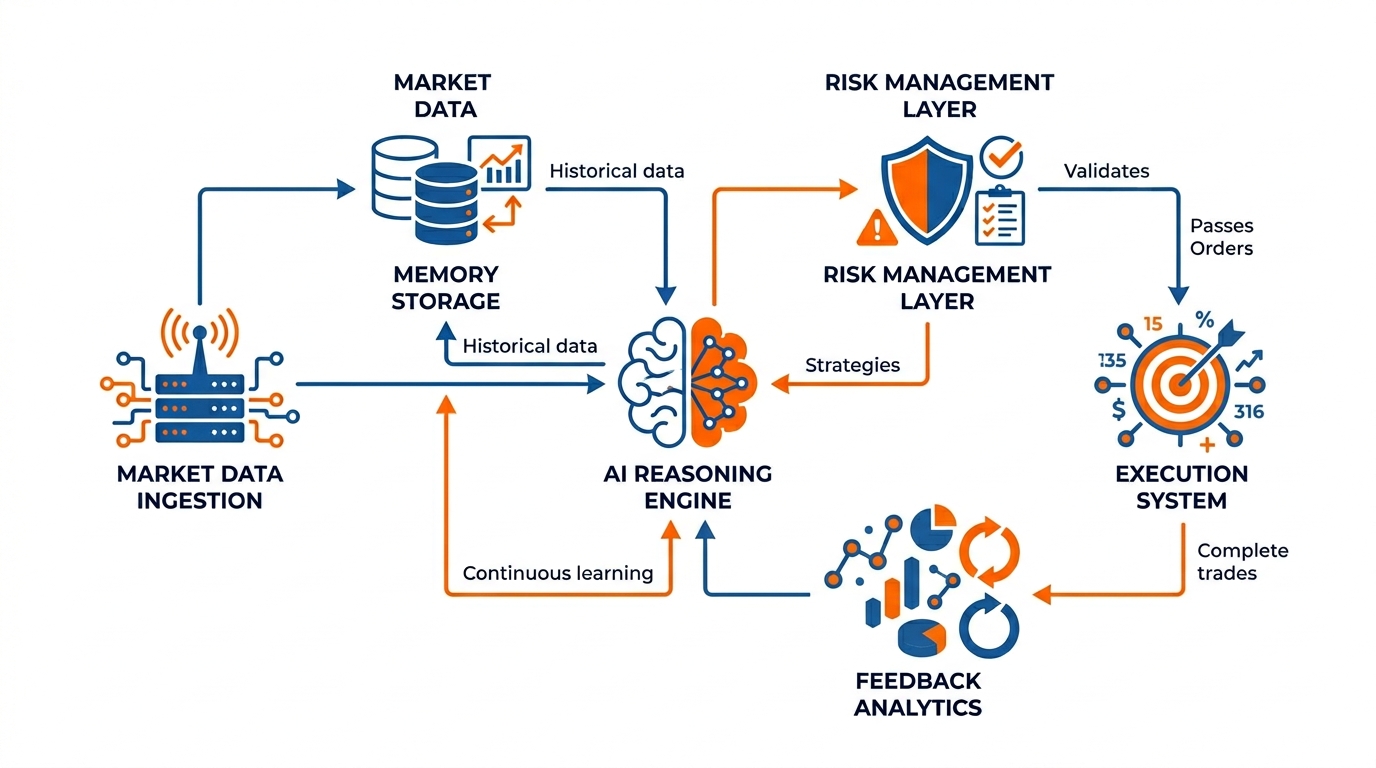
- The core system components — data, memory, reasoning, risk, execution, feedback
- Multi-agent trading frameworks
- Python implementation patterns
- Best practices for building production-ready AI trading systems
What Is an AI Trading Agent?
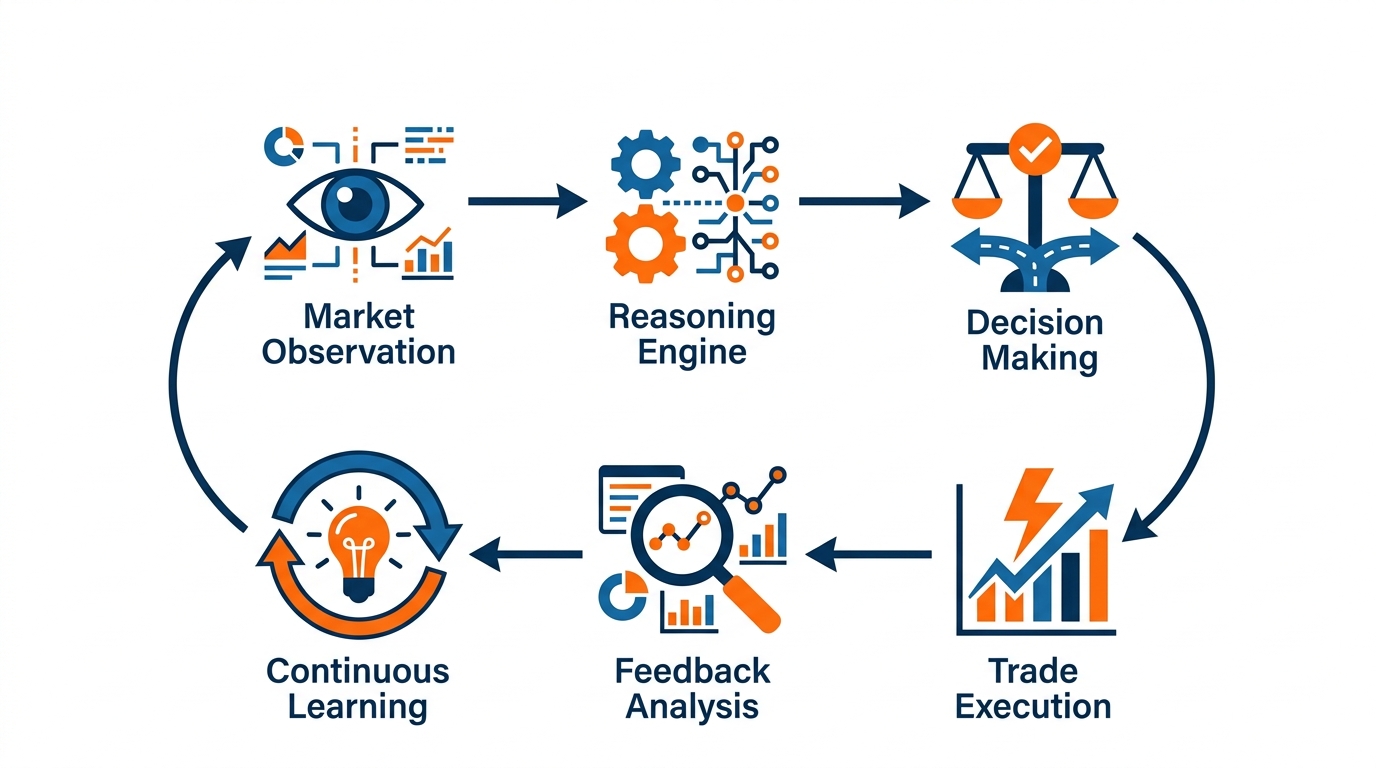
An AI trading agent is a software entity that can observe market conditions, process information, make decisions, execute actions, evaluate outcomes, and adapt behavior.
The agent operates in a continuous loop:
Observe → Analyze → Decide → Execute → Learn
Unlike traditional rule-based systems, agents operate within an environment and continuously interact with it. This cycle forms the foundation of modern autonomous trading systems.
Why Traditional Trading Bots Are No Longer Enough
Most trading systems today are rule-driven:
1if ema_fast > ema_slow:
2    buy()
Simple. Reliable. Easy to understand. However, markets constantly evolve. A strategy that works during trending conditions may fail during ranging markets. Traditional systems typically lack context awareness, adaptive behavior, dynamic strategy selection, and self-evaluation mechanisms.
The goal is not merely automation — the goal is intelligent automation.
Core Architecture of an AI Agent Trading System
Layer 1: Data Collection and Market Intelligence
Everything begins with data. An agent cannot make intelligent decisions without understanding its environment:
| Data Source | Examples |
|---|---|
| Market Data | OHLCV candles, order books, trade history, funding rates |
| Alternative Data | News feeds, social sentiment, on-chain metrics, economic releases |
| Internal Data | Portfolio state, trade history, current exposure, risk metrics |
1market_state = {
2    "price": current_price,
3    "volume": current_volume,
4    "volatility": current_volatility,
5    "trend": trend_signal
6}
In production systems, market states may contain hundreds of features.
Layer 2: Memory Systems
Without memory, every decision becomes isolated. Memory categories:
- Short-Term Memory: recent candles, open positions, current market regime
- Long-Term Memory: past trades, strategy performance, regime statistics
- Episodic Memory: major losses, exceptional profits, black swan events
Memory enables learning from past outcomes — the defining characteristic of an intelligent agent.
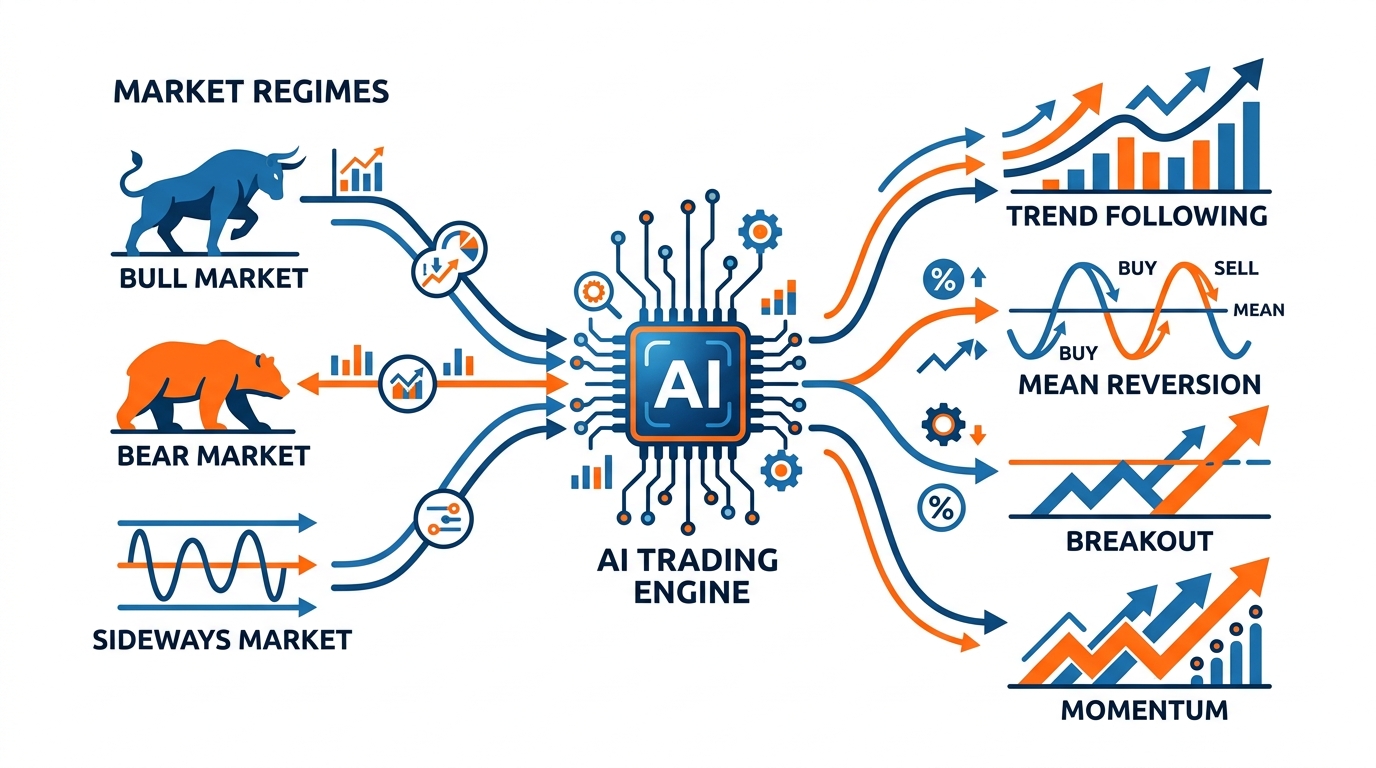
Layer 3: Market Regime Detection Agent
Markets alternate between trending, ranging, volatile, and low-volatility conditions. Different strategies perform differently in each:
1if volatility > high_threshold:
2    regime = "volatile"
3elif trend_strength > trend_threshold:
4    regime = "trending"
5else:
6    regime = "ranging"
This classification allows the system to adapt behavior dynamically.
Layer 4: Strategy Selection Agent
Dynamic strategy allocation based on market conditions:
| Market Regime | Strategy |
|---|---|
| Trending | Trend following |
| Ranging | Mean reversion |
| High Volatility | Breakout trading |
| Low Volatility | Options/range-bound strategies |
The agent chooses the strategy most likely to perform under current conditions — producing more robust performance than static systems.
Layer 5: Reasoning and Decision Engine
This is where intelligence resides. The decision engine evaluates market conditions, risk exposure, strategy recommendations, and historical outcomes. Possible actions: Buy, Sell, Hold, Reduce exposure, Increase exposure.
The objective is not predicting prices perfectly — it is maximizing long-term expected outcomes. Modern implementations may use reinforcement learning, large language models, Bayesian systems, or ensemble models. The specific technology matters less than the overall architecture.
Layer 6: Risk Management Agent
The most important agent is often the one that says "no." Risk agents monitor portfolio exposure, drawdowns, correlation risk, position sizing, and market volatility.
Position sizing:
The risk agent can override trading decisions if risk exceeds acceptable limits — creating a critical safety layer.
Layer 7: Trade Execution Agent
1order = {
2    "symbol": "BTCUSDT",
3    "side": "BUY",
4    "quantity": qty
5}
6exchange.execute(order)
Execution agents handle order placement, slippage control, exchange communication, and fill monitoring. Decision quality means little without execution quality.
Multi-Agent Trading Architecture
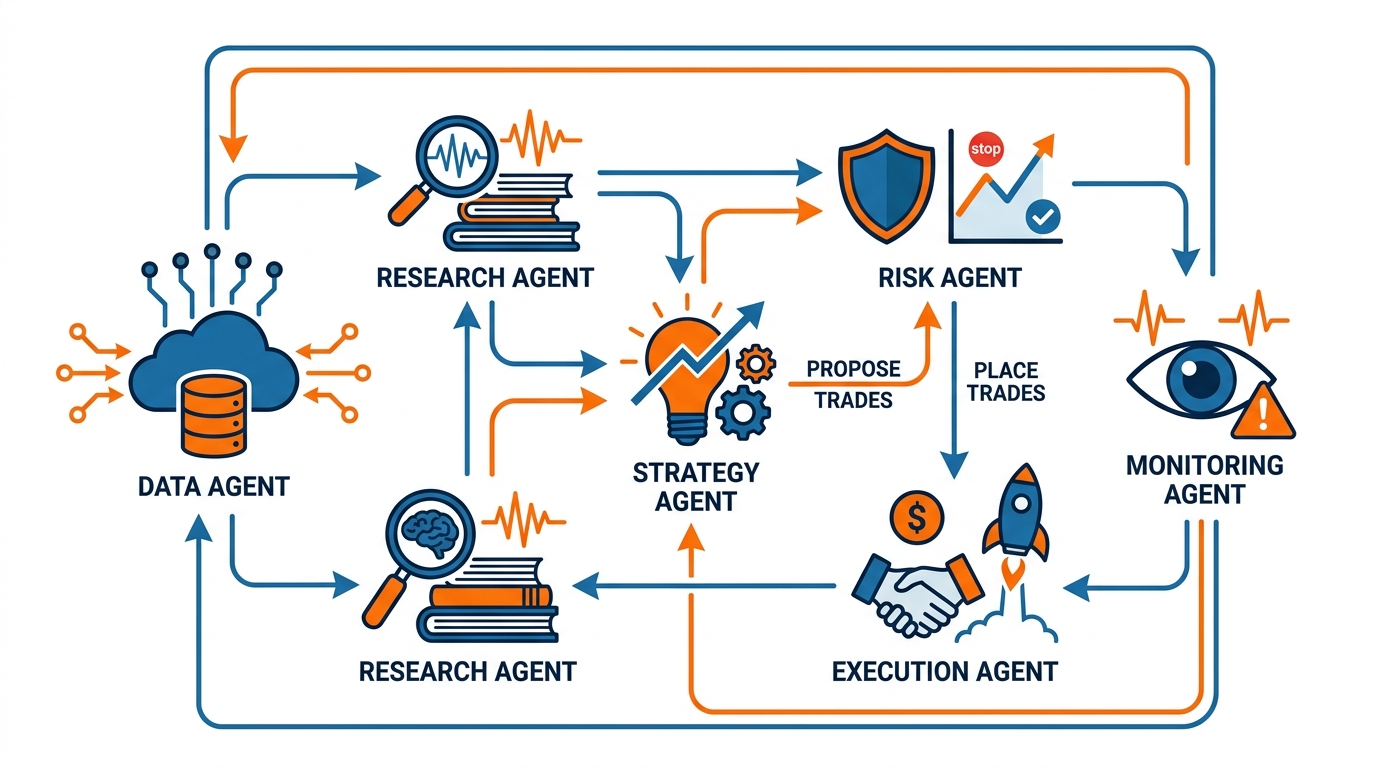
As systems mature, responsibilities are separated across specialized agents:
Data Agent → Research Agent → Strategy Agent → Risk Agent → Execution Agent → Monitoring Agent
This structure improves modularity, scalability, and testability. Each agent can be developed, tested, and optimized independently.
Feedback Loops and Continuous Learning
The most powerful systems improve over time. Every trade produces information. Performance metrics include returns, Sharpe Ratio, maximum drawdown, and win rate. Agents use these to evaluate their own effectiveness.
Continuous learning is what separates intelligent systems from static automation.
Building an AI Agent Framework in Python
1class TradingAgent:
2    def observe(self, market):
3        """Collect and normalize market state"""
4        pass
5
6    def analyze(self):
7        """Process observations, detect patterns, assess conditions"""
8        pass
9
10    def decide(self):
11        """Select action based on analysis and risk constraints"""
12        pass
13
14    def execute(self):
15        """Place orders, monitor fills, handle errors"""
16        pass
This base class separates responsibilities clearly. Additional agents inherit and specialize specific tasks. This modular approach improves maintainability and scalability.
Monitoring and Production Infrastructure
Many trading systems fail not because of strategy quality but because of operational issues. Monitor exchange connectivity, data integrity, position exposure, order failures, and system latency.
Production architecture includes databases, message queues, logging systems, alerting systems, and dashboards. Without observability, autonomous systems become impossible to trust.
Common Mistakes When Building AI Trading Agents
| Mistake | Reality |
|---|---|
| Focusing only on models | Models are one component — architecture, data pipelines, and execution matter equally |
| Ignoring risk controls | Risk agents must have veto authority — not just advisory |
| Building monolithic systems | Modular agent architectures enable independent development and testing |
| Ignoring feedback loops | Without outcome feedback, the system cannot adapt or improve |
| Overcomplicating early versions | Start simple, validate core assumptions, then introduce complexity gradually |
Advanced AI Agent Capabilities
As systems mature, additional agents become possible: portfolio optimization agents, news analysis agents (LLM-based), on-chain analysis agents, reinforcement learning agents (learning directly from market interaction), and multi-modal research agents (synthesizing insights from unstructured data).
Key Takeaways
- AI agents are systems, not just models — the architecture matters more than any single component
- Data collection forms the foundation; memory enables learning from experience
- Regime detection improves adaptability; strategy selection should be dynamic, not static
- Risk management must have authority to override trading decisions
- Multi-agent architectures improve scalability, testability, and robustness
- Feedback loops enable continuous improvement — the defining trait of intelligence
- Monitoring and observability are essential for trusting autonomous systems in production
Conclusion
For years, algorithmic trading focused primarily on rules and signals. The next evolution is autonomous intelligence. AI agents offer a framework for building systems that not only execute trades but also understand market conditions, adapt to changing environments, manage risk dynamically, and continuously improve through experience.
The true power of AI trading agents does not come from predicting every market move correctly. It comes from creating a structured decision-making architecture capable of operating intelligently under uncertainty.
The future of trading is not simply faster algorithms. It is intelligent systems that can observe, reason, decide, learn, and evolve. The question is no longer whether AI agents will become part of trading — the question is how sophisticated your agent architecture will be when they do.