

Advanced OHLCV Data Engineering for Crypto Bots
Master advanced OHLCV data engineering for crypto bots — real-time candle construction from tick data, WebSocket pipelines, multi-timeframe aggregation, timestamp synchronization, and scalable database storage.
Advanced OHLCV Data Engineering for Crypto Bots
Most beginner trading bots fail long before the strategy itself fails.
The indicators may look profitable. The backtests may appear impressive. The entries may seem logical.
But hidden underneath the system is usually a fragile data pipeline quietly corrupting everything.
Missing candles. Duplicate records. Delayed updates. Timestamp drift. Inconsistent aggregation.
These problems rarely appear obvious at first. Yet they silently destroy algorithmic trading performance over time.
Professional trading firms understand something most retail traders overlook: data engineering is not a secondary skill in algorithmic trading — it is the foundation of the entire system.
Especially in crypto markets, where exchanges generate enormous amounts of real-time data every second, advanced OHLCV engineering becomes critically important.
In this guide, you will learn how professional trading systems engineer OHLCV market data pipelines for crypto bots.
You will learn:
- How OHLCV data works internally
- How candles are built from raw trades
- How professional systems handle streaming market data
- How to synchronize live and historical candles
- How to avoid common data engineering failures
- How scalable crypto data pipelines operate
- Python implementations for live OHLCV systems
By the end, you will understand how advanced crypto bots transform raw exchange activity into reliable market intelligence.
Why OHLCV Data Matters More Than Most Traders Realize
Most trading indicators depend entirely on OHLCV data.
OHLCV stands for Open, High, Low, Close, Volume.
Indicators like RSI, MACD, Bollinger Bands, ATR, and moving averages all depend on accurate candle construction.
If OHLCV data becomes corrupted, indicators immediately become unreliable. This creates false signals, incorrect entries, backtesting drift, execution inconsistencies, and hidden strategy instability.
Professional systems treat OHLCV engineering as mission-critical infrastructure.
Understanding How Candles Are Constructed
Candles are not magical exchange objects. They are aggregated summaries of raw trades over time.
Each candle contains opening trade price, highest trade price, lowest trade price, closing trade price, and total traded volume.
OHLCV Candle Formulas
Open price:
Where Ot is the candle opening price and Pfirst is the first trade price during the interval.
High price:
Where Ht is the highest trade price and P₁ to Pn are all trades during the interval.
Low price:
Where Lt is the lowest trade price.
Close price:
Where Ct is the final trade price during the interval.
Volume formula:
Where Vt is the total traded volume and vi is the volume of each trade.
These calculations form the foundation of nearly all technical analysis systems.
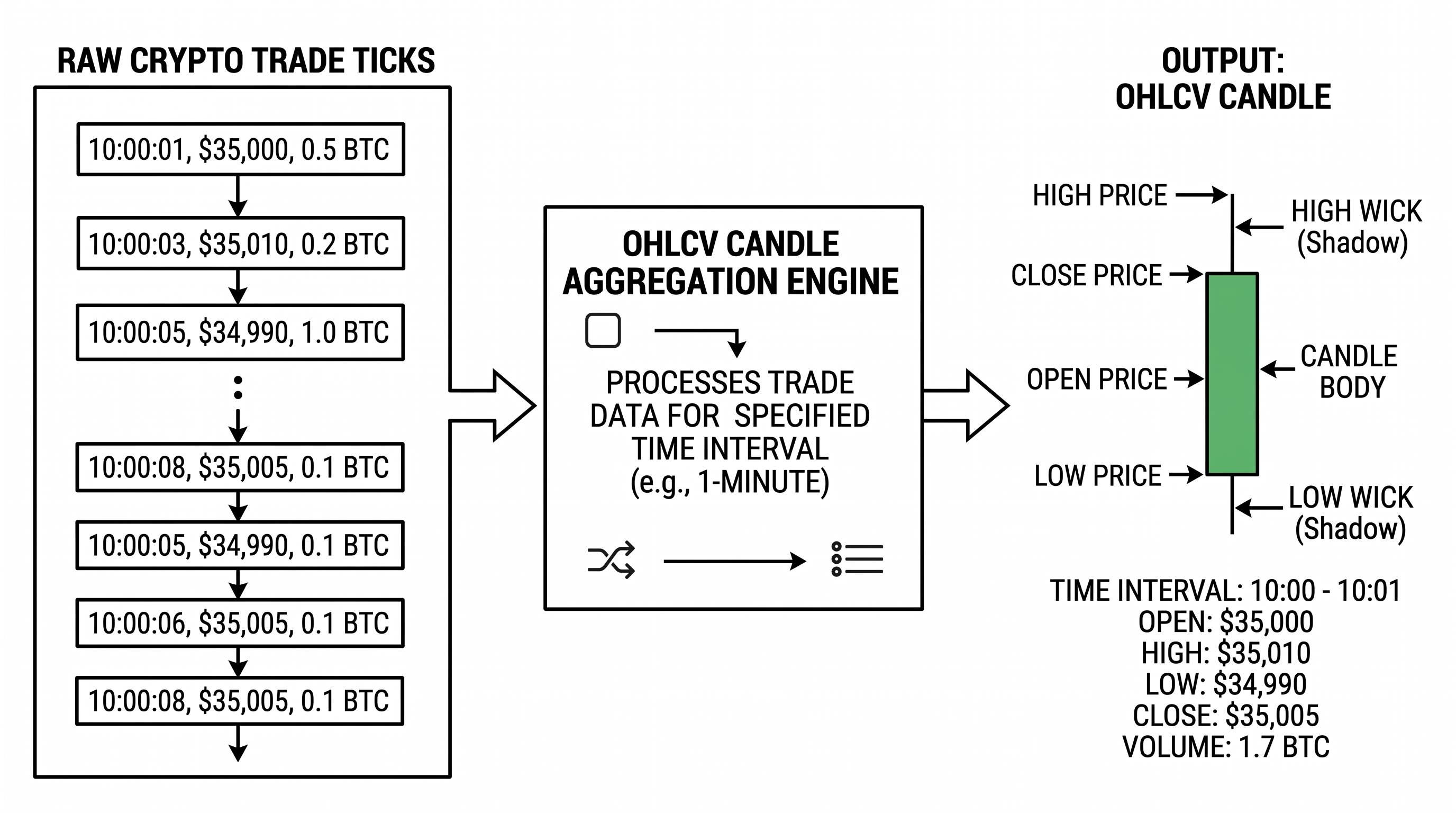
Why Raw Tick Data Is So Important
Many beginner systems only store candles. Advanced systems store raw tick data whenever possible.
Tick data includes trade price, trade quantity, trade timestamp, and aggressor side information.
This allows rebuilding candles later, tick-level backtesting, order flow analysis, and accurate replay systems. Without raw trades, correcting historical candle errors becomes extremely difficult.
REST APIs vs Streaming Data
Crypto exchanges usually provide two major data sources.
REST APIs
REST APIs are commonly used for historical candles, initial data synchronization, and backtesting datasets. REST is request-response based.
1import requests
2
3url = "https://api.binance.com/api/v3/klines"
4params = {"symbol": "BTCUSDT", "interval": "1m", "limit": 100}
5response = requests.get(url, params=params)
6print(response.json())
REST is simple but relatively slow.
WebSocket Streams
WebSockets stream live market updates continuously. This enables real-time candle construction, tick-level analytics, event-driven trading systems, and low-latency strategy execution. Professional systems heavily rely on streaming architecture.
Building Real-Time OHLCV Candles
One of the most important engineering tasks is constructing live candles from incoming trade streams.
Workflow: receive trade event → determine candle interval → update OHLC values → aggregate volume → finalize candle when interval closes.
Python Example: Live Candle Builder
1candle = {
2    "open": None,
3    "high": None,
4    "low": None,
5    "close": None,
6    "volume": 0
7}
8
9def update_candle(price, volume):
10    global candle
11    if candle["open"] is None:
12        candle["open"] = price
13    candle["high"] = max(candle["high"] or price, price)
14    candle["low"] = min(candle["low"] or price, price)
15    candle["close"] = price
16    candle["volume"] += volume
This continuously updates a live OHLCV candle from streaming trades.
Why Timestamp Alignment Is Critical
One hidden problem in crypto systems is timestamp inconsistency.
Problems occur when exchange timestamps differ, system clocks drift, or candles close at different intervals. This causes indicator mismatch, signal inconsistencies, and backtesting divergence.
Synchronization condition:
Where Tlocal is the local system timestamp and Texchange is the exchange timestamp. Professional systems normalize all timestamps to UTC.
Handling Missing Candles and Data Gaps
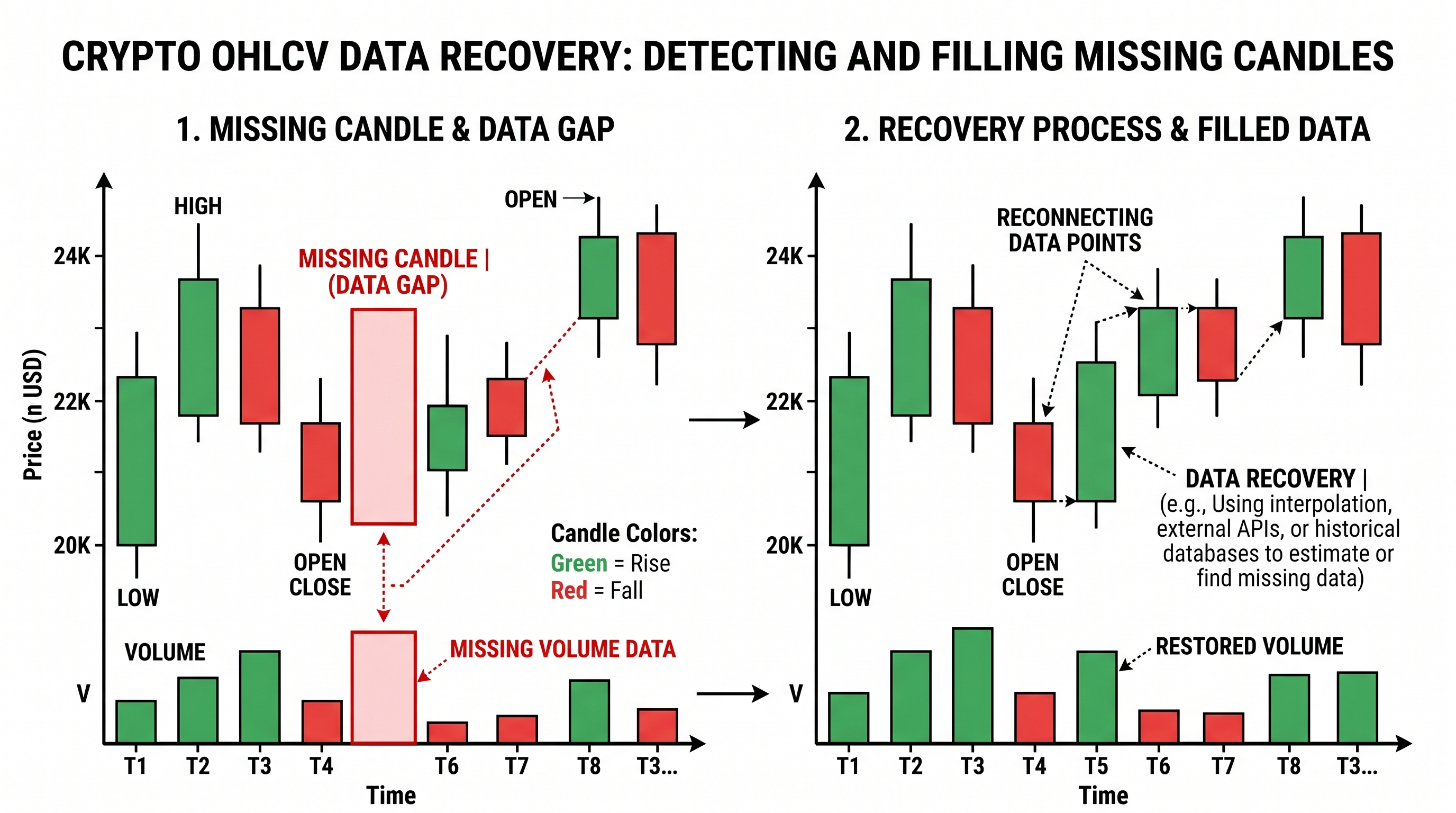
Crypto exchanges occasionally experience API outages, WebSocket disconnects, missing trades, and delayed updates.
Without recovery logic, trading systems silently degrade.
Professional pipelines implement gap detection, candle repair, historical backfill, and duplicate filtering.
Gap Detection Formula
Gap duration:
Where Gap is the elapsed time between records, Tcurrent is the latest timestamp, and Tprevious is the previous timestamp. Large gaps often indicate missing market data.
Multi-Timeframe OHLCV Aggregation
Professional systems rarely use only one timeframe. They often generate 1-second, 1-minute, 5-minute, and 1-hour candles all from the same underlying trade stream.
Multi-Timeframe Aggregation Formula
Higher timeframe volume:
Where VHTF is the higher timeframe volume and VLTF is the lower timeframe candle volume. This enables efficient hierarchical candle construction.
Why Database Design Matters
OHLCV pipelines generate enormous amounts of data. Poor database design creates slow queries, storage bottlenecks, delayed analytics, and strategy lag.
Professional systems optimize for append-only writes, partitioned storage, time-series indexing, and compression efficiency.
Popular databases include QuestDB, ClickHouse, TimescaleDB, and InfluxDB.
Python Example: Storing OHLCV Data
1import psycopg2
2
3conn = psycopg2.connect(
4    dbname="marketdata",
5    user="postgres",
6    password="password",
7    host="localhost"
8)
9cursor = conn.cursor()
10
11query = """
12INSERT INTO ohlcv (timestamp, symbol, open, high, low, close, volume)
13VALUES (%s, %s, %s, %s, %s, %s, %s)
14"""
15cursor.execute(
16    query,
17    (1680000000, "BTCUSDT", 65000, 65200, 64800, 65100, 250)
18)
19conn.commit()
20
21cursor.close()
22conn.close()
This creates persistent structured OHLCV storage for analytics and backtesting.
Event-Driven OHLCV Pipelines
Modern systems are event-driven. Instead of polling continuously:
- Exchange sends market event
- System updates candles
- Indicators recalculate
- Strategies evaluate signals
This dramatically reduces latency.
Throughput and Data Volume Challenges
Crypto markets generate massive event streams. Large exchanges may produce thousands of trades per second, millions of daily events, and gigabytes of market data.
Pipeline throughput formula:
Where Throughput is processed events per second, Nevents is total incoming events, and Δt is the processing interval. Scalable systems are required for high-volume trading environments.
OHLCV Data Validation Techniques
Professional systems validate data constantly.
Validation checks include missing timestamps, duplicate candles, negative volume values, and incorrect price ordering.
Example condition:
Where Lt is the candle low price, Ot is the open, Ht is the high, and Ct is the close. Violations often indicate corrupted data.
Common OHLCV Engineering Mistakes
- Trusting Exchange Candles Blindly — Exchange-generated candles occasionally contain inconsistencies; validate independently
- Ignoring WebSocket Recovery — Live streams eventually disconnect; recovery mechanisms are mandatory
- Using Local Timezones — Always normalize timestamps to UTC
- Storing Only Candles — Raw trade storage improves future flexibility dramatically
- Mixing Data Sources Improperly — Different exchanges may structure OHLCV data differently; normalization is essential
Why Advanced Traders Obsess Over Data Infrastructure
Beginners optimize indicators. Professionals optimize infrastructure.
Because even the best strategy becomes unreliable when candles are delayed, trades are missing, volumes are incorrect, or timestamps drift.
Reliable OHLCV engineering improves backtesting accuracy, signal consistency, execution quality, and strategy robustness.
Key Takeaways
Advanced OHLCV data engineering is one of the most important components of professional crypto trading systems.
- OHLCV candles are built from raw trades
- WebSocket streams power live candle systems
- Timestamp synchronization prevents signal drift
- Gap detection improves data reliability
- Multi-timeframe aggregation increases flexibility
- Databases are critical for scalability
- Event-driven pipelines reduce latency
Conclusion
Most algorithmic traders underestimate the importance of market data engineering.
But over time, nearly every serious trader reaches the same conclusion: reliable data infrastructure creates reliable trading systems.
Start simple: learn live candle construction, store raw trade data, normalize timestamps carefully, implement recovery systems, validate OHLCV integrity continuously, and build scalable event-driven pipelines.
As your infrastructure improves, your indicators, backtests, and execution quality improve alongside it.
Because in professional crypto trading, data engineering is not just support infrastructure. It is part of the edge itself.