

Adaptive Trading Strategy for Changing Crypto Market Conditions
Build an adaptive trading strategy that adjusts to changing crypto market regimes. Learn volatility detection with ATR, trend strength analysis with ADX, regime classification, dynamic stop-loss and position sizing, and Python automation for resilient systems.
Introduction
Markets do not fail traders nearly as often as traders fail to adapt.
A breakout system thrives during trending conditions, then collapses during sideways consolidation. Mean reversion strategies perform beautifully in ranging markets, only to get destroyed when volatility explodes. Most beginner traders search for a "perfect strategy." Experienced algorithmic traders search for adaptability.
An adaptive trading strategy recognizes changing market conditions and adjusts accordingly — modifying entries, exits, stop-loss distances, position sizing, or even strategy logic depending on volatility, trend strength, and liquidity.
In this guide, you will learn how to build a trading framework that evolves with the market instead of fighting against it, with Python automation.
Why Most Trading Strategies Eventually Stop Working
A strategy can be statistically profitable and still lose money for months because markets constantly rotate between conditions. Trend-following dominates during high momentum but underperforms during low-volatility consolidation. Scalping performs well in stable liquidity but fails during aggressive news-driven volatility.
Adaptive trading answers one critical question: "What kind of market are we trading right now?" Instead of treating every candle equally, adaptive systems classify environments before making decisions.
What Is an Adaptive Trading Strategy?
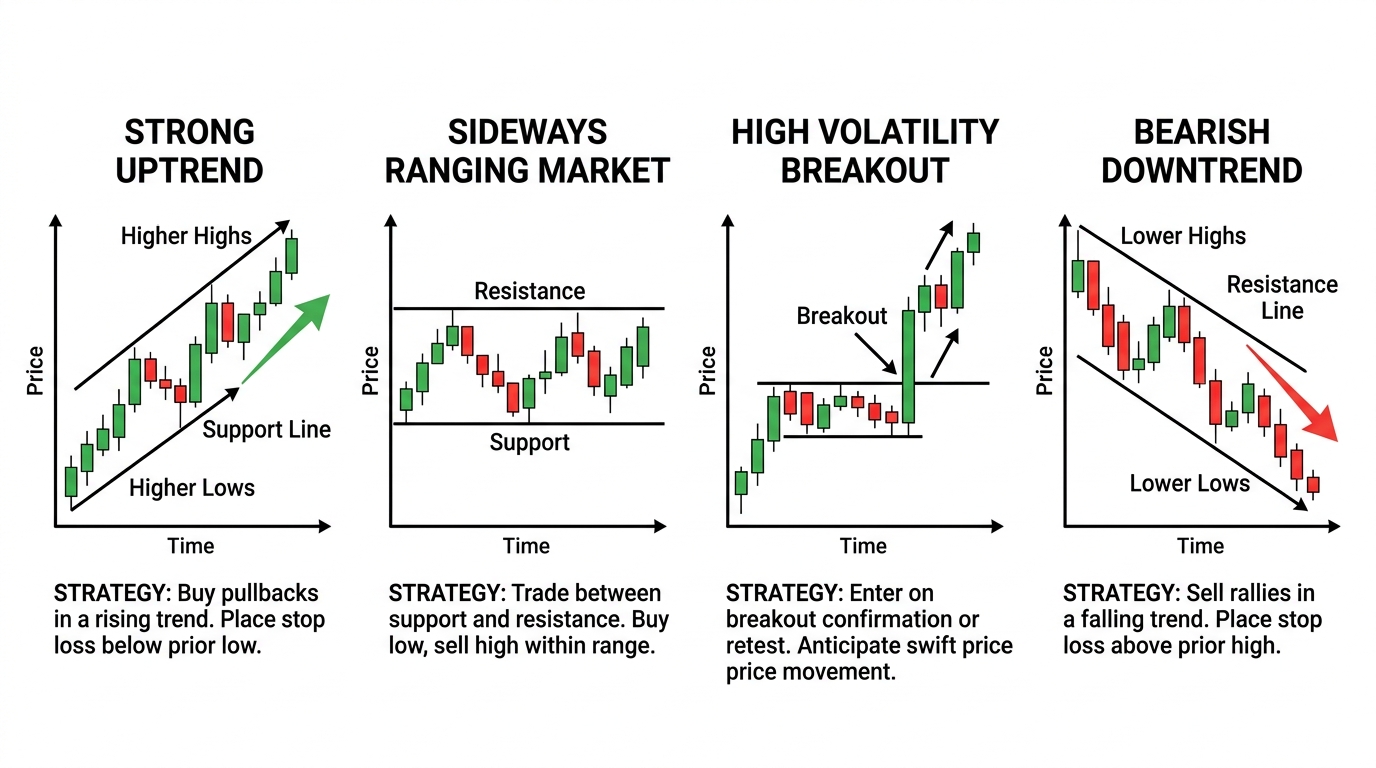
An adaptive strategy changes behavior based on market conditions, dynamically adjusting indicator sensitivity, stop-loss distance, profit targets, position size, trade frequency, and trend filters:
- High volatility → wider stops, reduced position size
- Low volatility → reduced trade frequency, tighter stops
- Strong trends → favor breakout entries, wider profit targets
- Ranging markets → switch to mean reversion or stay out
This flexibility helps traders survive every phase of the market cycle.
The Core Components
Volatility Detection (ATR)
ATR = (1/n) Σ True_Range
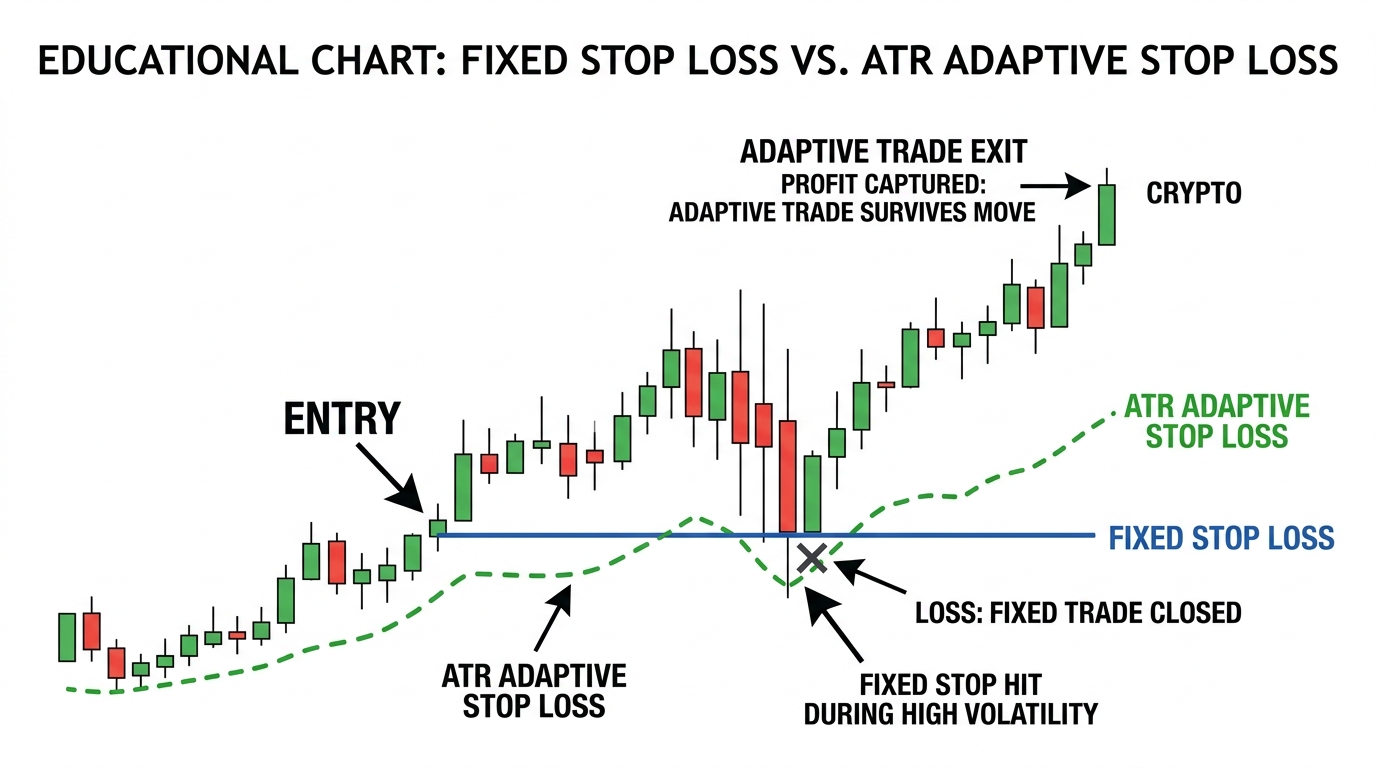
When ATR rises, volatility increases. When ATR falls, the market quiets. Adaptive systems use ATR to modify stop-loss placement dynamically:
Adaptive_Stop = ATR × 2 (volatile) or ATR × 1.2 (calm)
Trend Strength Analysis (ADX)
ADX values above 25 indicate strong trends. If ADX remains low, the system may avoid trend-following entries entirely — preventing death by a thousand whipsaws.
Market Regime Classification
Classify markets as trending, ranging, high volatility, low volatility, bullish, or bearish. High ADX + rising volume → breakout conditions. Low ATR + weak momentum → consolidation. Once the regime is identified, the strategy adapts automatically.
Building an Adaptive Crypto Trading System
Step 1: Detect Volatility
1import pandas as pd
2
3df['high_low'] = df['High'] - df['Low']
4df['high_close'] = abs(df['High'] - df['Close'].shift())
5df['low_close'] = abs(df['Low'] - df['Close'].shift())
6df['true_range'] = df[['high_low', 'high_close', 'low_close']].max(axis=1)
7df['ATR'] = df['true_range'].rolling(14).mean()
Step 2: Detect Trend Strength
1df['EMA_20'] = df['Close'].ewm(span=20).mean()
2df['EMA_50'] = df['Close'].ewm(span=50).mean()
3df['trend'] = df['EMA_20'] > df['EMA_50']
Step 3: Adapt Trade Logic Dynamically
1if atr_value > atr_threshold:
2    stop_loss = atr_value * 2.5   # wider during volatility
3else:
4    stop_loss = atr_value * 1.2   # tighter during calm
During volatile conditions, stops widen to avoid premature exits. During calm markets, tighter stops improve risk efficiency.
Why Static Stop Losses Fail in Crypto
A fixed 1% stop may work during calm conditions but becomes useless during volatility spikes. Adaptive traders scale risk using volatility-based positioning:
Position_Size = Risk_Per_Trade / (ATR × k)
This automatically reduces position size during volatile periods — a single adjustment that dramatically reduces drawdowns.
Combining Multiple Indicators for Adaptability
- EMA for trend direction
- ATR for volatility measurement
- RSI for momentum exhaustion
- Volume for breakout confirmation
Only buy when EMA trend is bullish, ATR exceeds minimum threshold, volume rises above average, and RSI is not overextended. This creates layered, adaptive filtering.
Adaptive Scalping vs Adaptive Swing Trading
Scalping: reduce frequency during high spreads, avoid low-volume sessions, tighten exits during weak momentum, increase confirmation during volatility spikes. Swing: use wider ATR stops, shift profit targets dynamically, hold longer during strong trends, exit faster during volatility contractions.
Volume as an Adaptive Filter
Volume_Ratio = Current_Volume / Average_Volume
If ratio exceeds 1.5, breakout conviction is stronger. Adaptive systems avoid weak setups automatically by filtering on participation.
Risk Management in Adaptive Trading
The greatest advantage is survivability, not higher profit. Most accounts fail because traders refuse to adjust risk during dangerous conditions:
1if market_volatility > threshold:
2    risk_per_trade = 0.5   # reduce exposure
3else:
4    risk_per_trade = 1.0   # normal exposure
Common Mistakes
Over-Optimization
Systems so complex they stop working outside historical data. Adaptive logic should remain simple and robust.
Switching Too Frequently
Overreacting to short-term losses and constantly modifying the system. Adaptation must be rule-based, not emotional.
Ignoring Transaction Costs
Adaptive systems often trade more frequently. Always account for fees, slippage, spread, and latency.
Simple Adaptive Trading Workflow
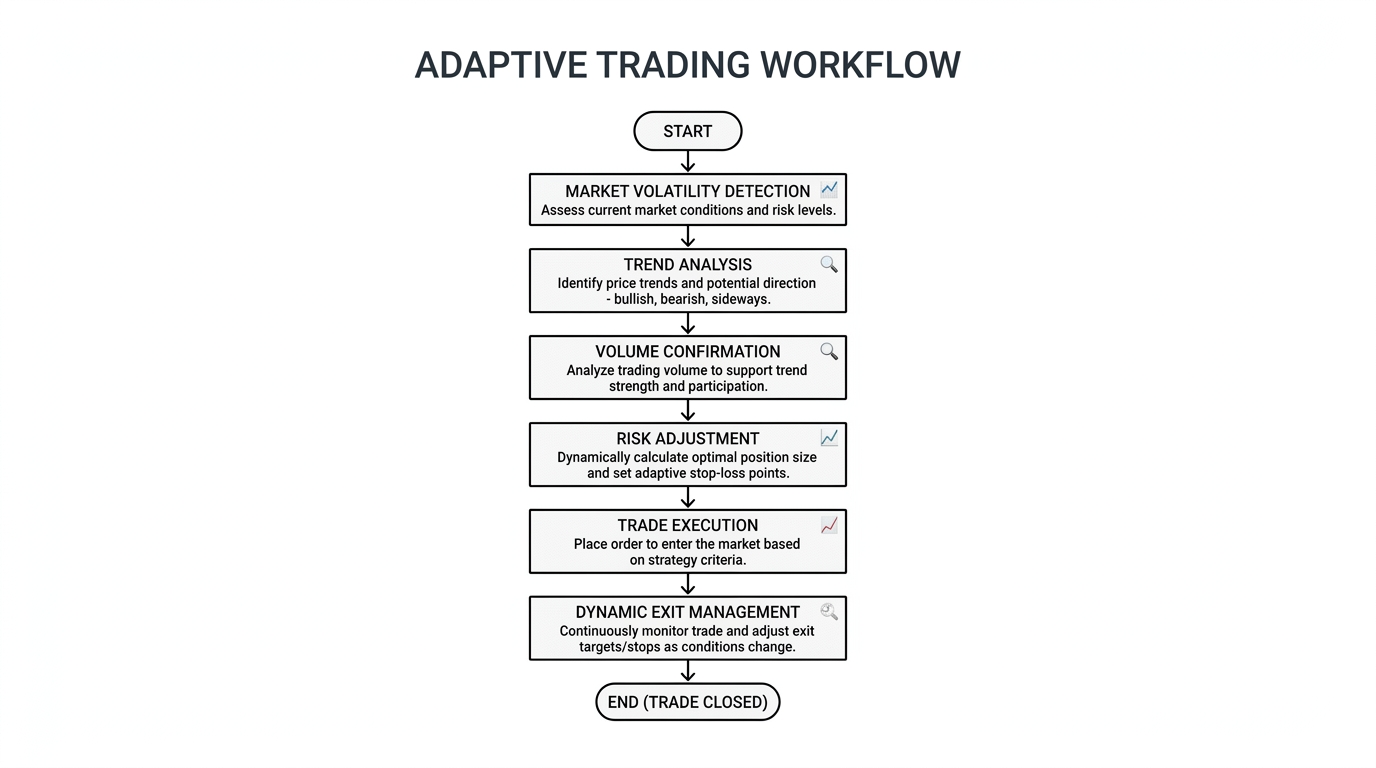
- Measure volatility (ATR)
- Detect trend direction (moving averages)
- Confirm participation (volume)
- Adjust stop-loss dynamically
- Scale position size by volatility
- Avoid trading during unclear conditions
Key Takeaways
- Markets constantly change between trends, ranges, and volatile phases
- Static systems fail because they ignore changing conditions
- Adaptive strategies adjust dynamically using volatility and trend analysis
- ATR helps scale stops and position sizing intelligently
- Volume filters improve breakout quality
- Adaptive risk management reduces drawdowns during dangerous periods
- Simplicity is more robust than over-engineered complexity
Conclusion
The future of algorithmic trading is not about finding one magical indicator. It is about building systems capable of adapting.
The best traders are not those who predict every move correctly. They are the traders who adjust faster than everyone else when conditions change. Adaptive trading strategies give you that flexibility — surviving ranging markets, exploiting momentum phases, reducing exposure during chaos, and maintaining consistency across different environments.
Start simple. Build a small adaptive framework using ATR, moving averages, and volume filters. Backtest it across multiple market conditions. Observe how performance changes when the system reacts dynamically instead of rigidly.
The market evolves every day. Your strategy should too.